By Nina Bacabac
It's 9:15 on a Wednesday night. You're at your kitchen table, not at any of your sites, and you want to know one simple thing: is everything getting cleaned? So you start the ritual. Text the supervisor on the east route. Call the one on the west who never texts back. “Did Maria show at the medical plaza?” “Is the bank done yet?” Three calls and two unanswered texts later, you've got a fuzzy picture and a cold dinner.
This is how a lot of operators run visibility: by phone, after the fact, one anxious question at a time. It works, sort of, until you've got more sites than you can hold in your head. Then it's just noise and worry. The better version isn't more calls — it's not needing them. Real cleaning operations management means you open one screen and see what's happening across every site, live, without dialing a soul. The right commercial cleaning software turns “call and find out” into “glance and know.”
You shouldn't have to call three people to find out whether the work got done. Real-time cleaning operations management puts shift status, no-shows, and task completion on one screen — so you see your whole operation at a glance, not after the complaint.
The phone-tag way of knowing things
Running on phone calls feels like control. It isn't. It's the opposite — you only know what someone remembers to tell you, when they get around to telling you. And by then it's usually too late to matter.
A cleaner no-shows at 8:30. Your supervisor notices around 9, finishes what he's doing, and texts you at 9:40. You see it at 10. By then the window's gone and the site's dark. You didn't have a coverage problem at 8:30 — you had one you could've solved. The phone just made sure you found out after it was unfixable.
And it scales the wrong way. With five cleaners at two sites, you can hold the whole operation in your head, and a couple of texts fills the gaps. Push that to twenty-odd people across a dozen buildings, and the phone stops being a tool — it turns into a second full-time job. More sites, more calls, more dropped threads, more nights spent reconstructing what happened from half-answers and best guesses. The method that got you here is the exact thing that buckles as you grow. You don't notice the ceiling until you've already hit it — usually on a night you couldn't afford to.
That's the real cost of phone-tag visibility. Not the minutes on calls. The fact that you're permanently one step behind reality, learning about tonight's problems tomorrow morning, usually from a client. Always reacting. Never ahead.
Status that updates itself
Modern janitorial services software changed the default. Instead of waiting for a human to report what happened, the system shows it as it happens.
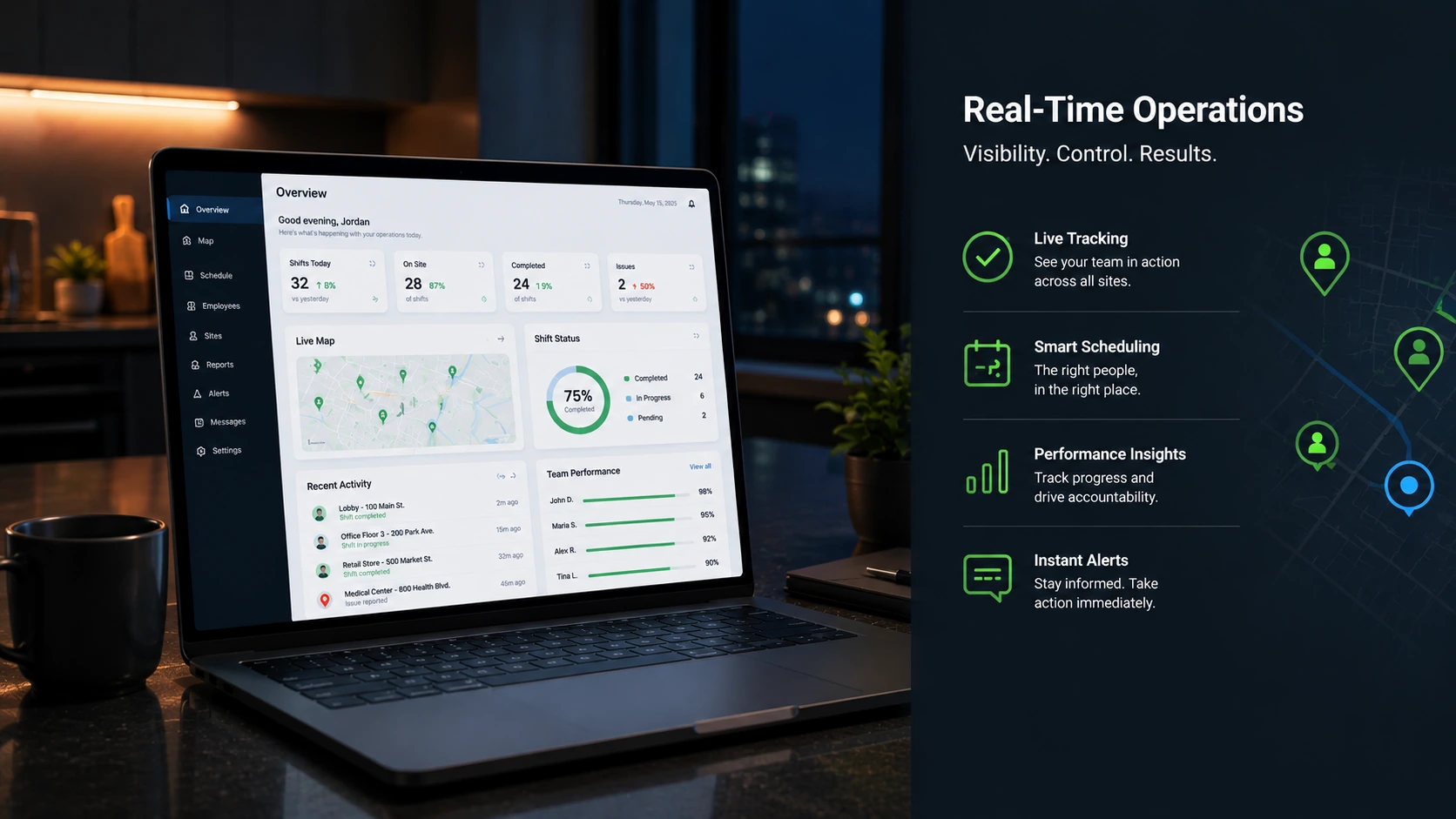
When a cleaner checks in on site, the shift flips from scheduled to started — right there on your back-office screen, no text required. Someone's late? You see late. Someone never shows? It surfaces as a no-show, in real time, sitting next to everyone who clocked in on time. There's a map view of the team, so “where is everybody tonight” stops being a question you have to ask anyone.
That's the quiet magic of it: nobody has to report status to you, because the act of doing the work is the report. Your supervisor isn't a relay station anymore. He's back to supervising, instead of texting you updates from a parking lot.
One screen. Every site. Live. The thing you used to chase by phone is now just sitting there, current, whenever you choose to look.
The dashboard that answers the only question that matters tonight
Open it up and the picture comes into focus fast. Appointment status across the board — on time, late, no-show. Task completion, so you can see what's actually done versus still open. Message-delivery failures, so a broadcast that didn't land doesn't quietly vanish. Issue resolution times. And the pattern that takes months to spot by phone: which people are reliable and which ones keep turning up as problems, surfaced through their check-ins and photo proof.
Now, a caveat worth being straight about. This isn't a profit-and-loss dashboard. It won't tell you your margin on the downtown account or how many labor hours you burned this week — that's not what it's built for. What it tells you is arguably more useful at 9 p.m.: is the work happening, and who can you count on to make it happen?
That's the heart of cleaning operations management. Not vanity metrics. The handful of signals that actually tell you whether tonight goes smoothly — and whether you can stop refreshing your phone and go to bed.
Your crew sees the same picture
Real-time visibility isn't a one-way mirror you watch your team through. It runs both directions.
Your cleaners open the app and see their own world clearly — active shifts, what's coming, what's done, what's still open. When a shift has tasks, they arrive as a checklist, so there's no guessing about scope. And if a task gets left incomplete, it flags the shift and prompts the cleaner to update it, with an optional note on why. Nobody has to call anyone to figure out what slipped or why.
It all lives in one cleaning management app — the same one they use to check in. For the people on the floor, that means less ambiguity and fewer “wait, was I supposed to do that?” moments. For you, it means the gaps show themselves instead of hiding until a client finds them first.
When your client stops calling too
Here's where “without calling anyone” gets really good: it extends to your client, too.
With ProTeams, your customer can have their own portal login. They can see the schedule — the same cleaning scheduling software view your office works from — and raise an issue when something's off, instead of leaving you a tense voicemail. On Growth and Scale plans, the service reports they care about arrive automatically, on the cadence you set.
So the property manager who used to call you at 7 a.m. for reassurance now just opens the portal and reassures herself. The anxious check-in calls thin out. The relationship gets calmer. And calm clients, as every operator learns eventually, are the ones who quietly renew.
Real time means before, not after
Strip it all down and the whole point is timing. Knowing a no-show happened last night is trivia. Knowing it's happening right now is power, because you can still do something about it.
That's the line between managing an operation and cleaning up after one. Visibility you get tomorrow morning is just a more detailed apology. Visibility you get tonight is a save.
Don't build it the morning a contract's already on the line. Build it now, while everything's quiet. So the next time it's 9:15 and you wonder if every site's covered, you don't reach for the phone. You just look.
Stop running your operation by phone call
You can't manage what you can only find out about after the fact. When status lives in scattered texts and late-night calls, you're always a step behind the problem — and your clients get there first.
ProTeams.io helps commercial cleaning companies centralize the systems that keep field operations moving:
- Crew scheduling and shift check-ins
- Field communication between office staff, supervisors, and cleaners
- Issue tracking and service requests
- Attendance visibility and field accountability
- Checklists and task completion follow-up
- Operational reporting across clients and locations
Put every site on one screen — and trade the nightly round of phone calls for a single, honest glance.