By Kana Nakajima
It's 6:50 on a Monday night and three of your sites still don't have confirmed coverage. So you do what you always do. You open the crew group chat and type: “Who can take the Riverside lobby tonight?” Nothing. Then a thumbs-up — from someone who isn't even on this week's rotation. Twenty minutes later, two replies land, both half-committed, after the window's already gone tight. Sound familiar?
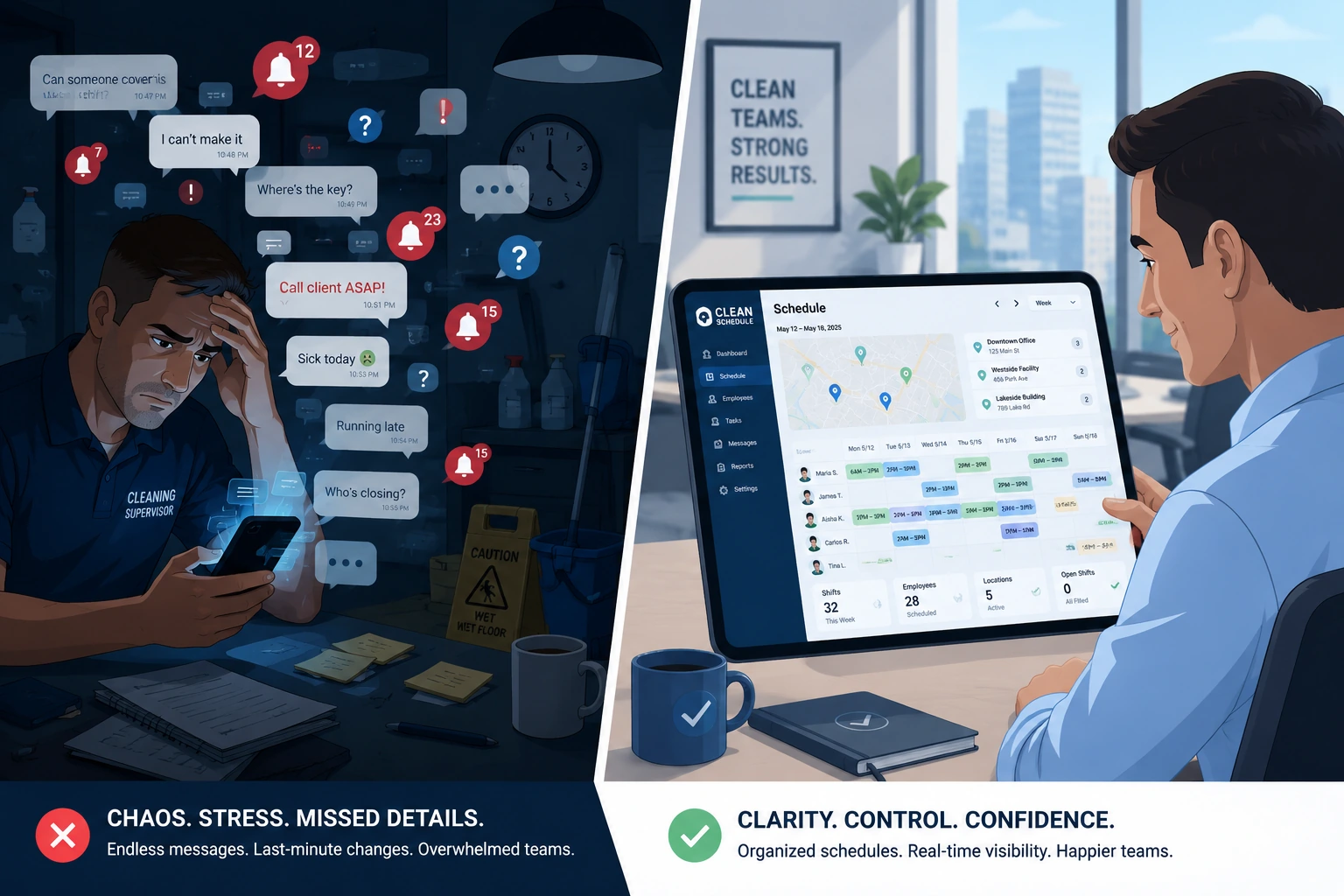
For a lot of commercial cleaning operators, the group chat is the dispatch system. It's fast. It's free. And it's quietly costing you contracts. The problem was never the app. It's that a group thread was never built to run a field operation. It can't tell you who's actually working tonight, who's running late, or whether your message even reached the person it was meant for. Decent cleaning business management software can do all three. That's the gap — the quiet one — that turns a small coverage hiccup into a client phone call you really didn't want to take. And those calls have a way of adding up to a non-renewal.
Group chats can't run a cleaning operation — and the cost shows up where it hurts most: lost contracts. Cleaning scheduling software trades the scroll-and-guess of a group thread for one schedule, real-time shift status, and a record of what actually happened on site.
The group chat felt free. It wasn't.
Here's the lie nobody tells you about running dispatch from a group chat: it isn't free. You're paying for it. Just not on an invoice.
You pay in missed coverage, when a “who's free?” message scrolls past three people who would've said yes. You pay in supervisor hours, when the same shift gets re-typed four times because nobody's sure it stuck. You pay every morning in the fifteen or twenty minutes someone burns scrolling up to reconstruct who actually agreed to what. Multiply that across a week. Across a month. It's real money, and it's coming straight out of your margin.
Then there's the part that actually loses contracts. A message in a thread isn't an assignment. It's a hope. You hope the right cleaner saw it. You hope they're on their way. You hope the lobby gets done before the property manager walks through at 7 a.m. Hope isn't a system.
And when something slips — a no-show, a skipped floor, a site that went dark — the group chat gives you nothing to work with. No status. No timeline. Just a wall of messages and a client who noticed before you did. That's the moment a contract starts to wobble.
What a group chat can't tell you
Ask your group chat a simple question: is the Riverside lobby being cleaned right now? It can't answer. It doesn't know. A purpose-built commercial cleaning software platform does.
When a cleaner checks in on site, the shift flips from scheduled to started — and you see it from the back office without texting a soul. Someone hasn't shown? It surfaces as a no-show in real time, right alongside who's on time and who's running late. You're not waiting for the client to tell you something's wrong. You already know.
There's the messaging side, too. When you broadcast a shift, it goes out by push notification, by email, and by optional text — not into a single thread where it competes with lunch plans and weekend chatter. And if a message fails to deliver, that failure shows up as something you can act on, instead of vanishing into the void. A group chat can't promise delivery. It can't even tell you when it failed.
What it comes down to is this: a group chat shows you conversation. A real system shows you the work. Who's reliable. Who's not. What got done, and what didn't. That's the difference between managing a feeling and managing an operation.
One schedule beats ten threads
So what replaces the thread? One schedule everybody works from.
That's where cleaning scheduling software earns its keep. You build the week on a single screen — single shifts, recurring shifts, the Tuesday-Thursday-Saturday accounts that never change — and you create, move, or cancel any of them without opening five separate conversations. Need to see where your team's spread tonight? There's a map view for that. Coverage stops being a memory exercise.
Once a shift is set, it broadcasts to the assigned cleaners. Push, email, optional text. Their choice of how they hear about it, your assurance that it went out. No more “I never saw that.”
Your crew sees the same source of truth on their phone, in the cleaning company app — active shifts, what's coming, what's done, what's still open. Not buried three days deep under “running late” texts. A cleaner opens the app at the start of a shift and knows exactly where to be and what the job includes, because the tasks ride along with the assignment as a checklist.
One schedule. One place the office and the field both trust. That's the whole point — and it's the thing a group chat structurally can't be, because a thread has no state. It only holds the last thing somebody typed.
This was never about messaging. It's about contracts.
Step back and the group chat problem isn't really about messaging at all. It's about retention.
Property managers don't cancel because of one missed bin. They cancel because they didn't feel heard. Because they reported the same issue twice and watched it disappear into a thread. Because they could never get a straight answer on whether last night's clean actually happened.
This is where a client-facing portal changes the math. With ProTeams, your customer can get their own login — they can see the schedule, raise an issue when something's off, and, when you bring them in, message the team directly. On Growth and Scale plans, the service reports they care about land in their inbox automatically, on the cadence you set. Weekly. Monthly. Whatever keeps them comfortable.
Most workforce tools stop at your office door. They're built to manage the crew and nothing else. A portal flips that — it lets the people who decide whether to renew watch the work getting done, close to real time. That's not a nice-to-have. That's the difference between a client who's anxious and a client who's loyal.
Contracts don't usually die from one bad night. They die from a hundred small moments of feeling ignored. Close that gap and you protect the revenue you already fought to win.
Switching off the group chat without the chaos
Nobody's asking you to rip out the group chat on a Friday and pray. You don't have to.
Start with one account. Move its recurring shifts into the schedule first — those are your predictable wins. Let the crew check in on site for a week and watch what shows up: the real start times, the quiet no-shows you used to learn about secondhand, the sites that run like clockwork. You'll learn more about your operation in five days than the group chat told you all year.
Then add the next account. And the next. The chat doesn't have to vanish overnight; it just stops being where the actual work gets dispatched. Good cleaning scheduling software is meant to slide under your operation, not flip it upside down.
Here's the honest version: the group chat was a workaround that worked until you grew. At five cleaners, a thread is fine. At twenty-five, across a dozen sites, it's a liability wearing the costume of convenience. The operators who cling to it longest tend to be the ones who lose a contract before they switch.
Don't wait for that phone call. Build the schedule before you need it.
Stop dispatching your contracts into a group chat
Every shift you run through a thread is a shift you can't see, can't verify, and can't prove happened. Your clients tend to notice that gap before you do — and that's how good contracts quietly slip away.
ProTeams.io helps commercial cleaning companies centralize the systems that keep field operations moving:
- Crew scheduling and shift check-ins
- Field communication between office staff, supervisors, and cleaners
- Issue tracking and service requests
- Attendance visibility and field accountability
- Checklists and task completion follow-up
- Operational reporting across clients and locations
Put your schedule, your crew, and your clients in one place — and replace “I hope someone saw that” with “I can see it's done.”