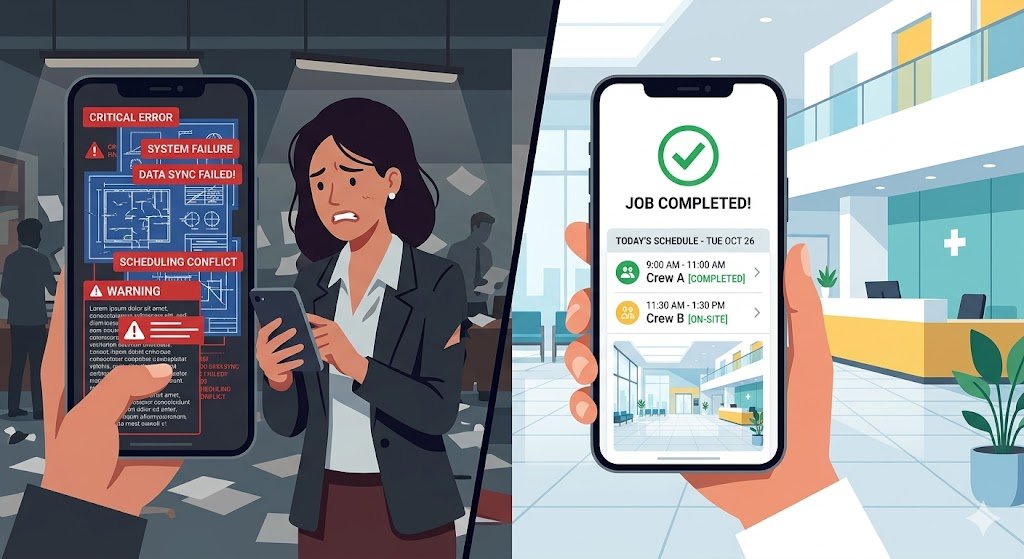
It's 1:15 on a Tuesday. A supervisor texts you from the downtown medical building: two cleaners didn't show, and the front desk is already making comments. You open the app you're paying for — the one a sales rep swore would run your whole operation — and it wants you to "create a work order" and "assign a technician to the job site." You don't dispatch technicians. You run recurring crews across nine buildings, every night, on contracts that renew or don't based on whether the work got done. That's the trouble with generic field service management software: it's built for a different industry, and you feel the seam every single day. If you've spent months forcing a break-fix dispatch tool to behave like real janitorial services software, you already know the feeling. Here's why the mismatch happens, where it actually costs you, and what to run instead.
What "field service" was actually built for
Field service software grew up around break-fix work. A unit goes down, a customer calls, you send one technician with the right parts, they fix it, you bill for the visit. HVAC. Elevators. Copiers. That's the DNA, and every assumption underneath generic field service management software traces back to that one-tech, one-job, one-invoice loop.
Cleaning doesn't work like that. You're not waiting for something to break. You're running the same buildings on the same nights, with crews — not solo techs — and the value isn't the visit, it's the consistency. Nobody calls to say the third-floor restrooms look great. They call when they don't.
So when you buy a tool built for dispatch, the friction starts on day one. The app keeps asking questions that don't apply, and you keep inventing workarounds. Every single night. A tool that misunderstands the job will misunderstand it a thousand times a week.
The features you're paying for that you'll never open
Open a generic field service platform and look at what's front and center. Parts inventory. Per-visit estimates. Drive-time routing between unrelated job sites. Invoicing tied to labor and materials on each call. All useful — if you fix things for a living.
You don't. A commercial cleaning operation needs a tighter, different set of tools: a recurring schedule it can trust, a fast way to know who showed and who didn't, proof the work happened, and a way to keep the client feeling looked after. Most field service tools do none of those well, because nobody ever asked them to. You end up paying for a loaded toolbox and using two wrenches.
The fix isn't more features. It's cleaning management software that starts from how cleaning actually runs — not a dispatch app with a cleaning label slapped on the box. The real cost was never just the subscription. It's every hour your team burns translating cleaning into a language the software refuses to speak.
Where the mismatch actually hurts
Generic tools don't fail everywhere at once. They fail at four specific moments — and each one maps to something purpose-built janitorial software handles differently.
- The recurring schedule. Cleaning runs on repetition, so your schedule has to think in recurring shifts, not one-off work orders. The right system lets you create, reschedule, and cancel single and recurring appointments from one screen — with a map view of where your team is — then broadcast every change to the crew by push, email, and optional text. Change Tuesday's coverage once. The whole team sees it. This completely eliminates
the real cost of WhatsApp dispatch - The no-show at 1:15. When two people don't turn up, you don't need an estimate or a parts list. You need to know now. Software built for cleaning shows no-show, late, and on-time starts in real time, so you can reassign and rebroadcast the open shift yourself before the client ever notices the gap.
- Proof the work happened. This is the one generic apps miss most. Cleaning's whole product is "it got done," and you need to prove it without standing in every building at midnight. Proof of Service lets cleaners document their own finished work with photos tied to the site — captured on-site (verified) or uploaded later (unverified) — with time stamps on completion. It isn't you inspecting them. It's the work documenting itself.
- The client who wants to see it. Most workforce tools are internal-only, so your customer never sees a thing. A client login changes that: the property manager can view their schedule and raise an issue directly, and on Growth and Scale plans they get service reports delivered on a set cadence. A client who feels looked after renews.
You're also measuring the wrong things
Here's the quieter failure. Generic field service management software reports on what it was built to value: revenue per job, billable hours, technician utilization. For a cleaning operator, those numbers answer questions you're not really asking.
What you actually need to know is simpler and harder. Is the work happening? Who's reliable? What's slipping before a client notices? That's accountability, not accounting. The right commercial cleaning software platform tracks the things that protect contracts — appointment status across on-time, late, and no-show; task completion; message delivery, including failures; and which people keep surfacing as problems, flagged by check-in patterns and photo proof.
Notice what's deliberately missing from that list: it won't hand you the margin on a single account. That's on purpose — the product tells you whether the work is getting done and who you can depend on, not what each contract costs. Different question. Different tool. And the truth most dashboards won't show you is this: you'll lose a contract long before margin ever enters the conversation, usually over a client who quietly stopped feeling looked after.
What to use instead: software built for the work
Stop bending a dispatch tool around a job it was never built for. Use software designed for commercial cleaning from the very first screen.
That's what ProTeams is. Crews carry an app on iOS and Android with their shifts and a digital checklist for each one. Office staff run everything from a web dashboard — schedule, field communication, issues, reporting — in one place. Cleaners check in, and their tasks live as a checklist that flags the shift if something's left incomplete, with a note on why. Proof of Service captures photos of the finished work, on-site or off. And your client gets a login to see their schedule and raise an issue directly, with automatic service reports on Growth and Scale.
None of that is bolted onto a break-fix core. It is the core. The right field service management software for a cleaning company isn't a field service app with cleaning crammed into it. It's built for the night shift, the recurring route, and the client who's deciding right now whether to renew.
Run cleaning operations on software that was built for cleaning
You shouldn't have to translate recurring crew work into work orders and parts lists every night. The mismatch isn't your fault — it's the wrong tool.
ProTeams.io helps commercial cleaning companies centralize the systems that keep field operations moving:
- Crew scheduling and shift check-ins
- Field communication between office staff, supervisors, and cleaners
- Issue tracking and service requests
- Attendance visibility and field accountability
- Checklists and task completion follow-up
- Operational reporting across clients and locations
See it running against your own buildings, your own crews, your own week.