
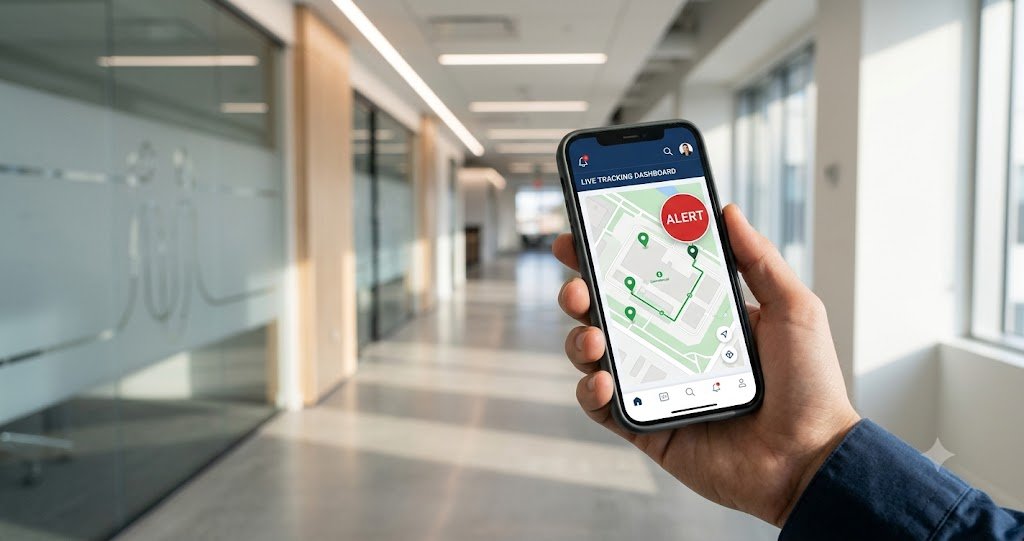
Real-time visibility in cleaning operations means shift status updates itself as the work happens. A cleaner checks in and the shift reads as started. A missed start surfaces as a no-show. A late arrival reads as late, on one screen, without anybody phoning it in. It answers the roll-call questions a supervisor used to answer by phone. It doesn't answer why, and it says nothing about whether the work was any good.
For years my day had a hole in it at 11 a.m. That's when I'd start the round. Call the east crew. Text the closer at the bank branch who never picks up. Wait. Forty minutes, some days an hour, spent assembling a picture of a morning that had already ended. I run operations at Verdant Building Service in Texas, and I'll say it plainly: that call was archaeology. I was digging up a morning I could no longer change.
A dashboard doesn't make the status call shorter — it deletes the part that was roll call. What's left is a four-minute conversation about the things a screen will never know. That's what real-time visibility is actually for.
What is real-time visibility in cleaning operations?
It's a system where doing the work produces the record, instead of a person producing the record afterward from memory. That single shift is the whole thing.
The mechanics are unglamorous. A cleaner opens the app and checks in. The shift flips from scheduled to started, timestamped. Nobody taps a button to confirm they got the assignment — there's no acknowledgment step in ProTeams, and there doesn't need to be, because checking in is the acknowledgment. If they don't check in, the shift sits there reading no-show while the site's still dark and the night's still salvageable.
Compare that to how most operations run. Somebody notices something. Somebody else gets told. You get told last. Every hop adds latency, and latency is the whole problem.
What does the daily status call actually cost?
The daily status call costs an operator most of a working day every month — and worse, it hands you every answer hours after the window to act has already closed.
Mine ran forty minutes on a good day. Five days a week. Do that arithmetic and it's most of a working day every month, spent producing information the system already had.
But the minutes aren't the expensive part. The latency is. At 11 a.m. I'd learn that the 6 a.m. crew never arrived at the medical plaza. Five hours dead. The building had been sitting there unserviced through the entire morning, and my first move was damage control, because the window to send someone had closed around 7:30. By then I was piecing the morning back together from half-remembered phone calls, hours after anything could be done about it.
The call also lies to you, quietly. Crews report what they remember, framed the way they'd like it framed. Nobody's malicious. They're just human, tired, and standing in a parking lot trying to answer six questions from memory. What you get is a picture that's roughly true and specifically wrong.
Which questions does a cleaning operations dashboard answer without a call?
A cleaning operations dashboard answers the questions that have a factual answer — who started, what's done, what failed — and leaves the judgment questions to you. Here's the honest split.
| On the screen, no call required | Still not on any screen |
|---|---|
| Who started on time, who's late, who's a no-show | Why the no-show happened |
| Which tasks are complete and which are still open | Whether the completed work was any good |
| Which broadcast messages failed to deliver | What the client said in the lobby this morning |
| How long issues take to resolve, and who keeps surfacing as a problem | Your margin on the account, or labor hours burned |
That right column earns a word. ProTeams tracks whether the work is happening and who's dependable. It doesn't do labor utilization, it doesn't do per-account profitability, and there's no custom report builder. Accountability, not accounting. I'd rather tell you that up front than have you find it out in month three.
Is this the same as live cleaning crew tracking?
No — real-time visibility records bounded events like check-ins and completions, while live cleaning crew tracking implies a continuous location trail, and the difference matters more to your crew than it does to you.
Live cleaning crew tracking, the way vendors usually mean it, is a moving dot: a breadcrumb through the building, a record of how long somebody stood on the fourth floor. ProTeams doesn't produce that. What it records are bounded events — a check-in, a task marked complete, a service completed — each stamped with a time. On Growth and Scale plans that check-in can be geofenced, so the clock-in only counts when the cleaner's actually on-site — presence confirmed, with not a single step of where they went afterward logged anywhere. The schedule view includes a map view of the team, which shows you where the day stands, not where everyone has been.
I've never met a cleaner who quit over a check-in screen. I've met plenty who'd walk over a moving dot. Turnover costs more than surveillance saves. If you want the fuller version of that argument, see how a whole operation looks on one screen.
What the status call still does that no dashboard replaces
A dashboard reports facts, but reasons live in a conversation — so killing the status call entirely is a mistake. This is the part the software companies skip, so I'll say it.
The dashboard tells me Marcus was forty minutes late. It doesn't tell me his kid was in the ER, that he drove straight from the hospital, that he'll be late Thursday too, and that he'd rather quit than ask. A no-show flag is a fact. It isn't a reason, and reasons are what you manage.
So the call survives, just unrecognizably. Mine's four minutes now, and it starts where the old one used to end. I already know who checked in. I already know which tasks got flagged incomplete and what the cleaner typed in the comment field about why. What I ask about is the stuff that never fits in a field. How's the new hire holding up. Is the client's new facilities guy going to be trouble. What are you seeing that I'm not.
Both of us walk in already knowing the status. So we spend the four minutes on everything the status can't hold.
Frequently Asked Questions
What is real-time visibility in cleaning operations?
It's shift status that updates itself as work happens. A cleaner checks in and the shift reads as started; a missed start surfaces as a no-show; a late arrival reads as late. The record builds from the work instead of from someone reporting on it afterward.
Does a cleaning operations dashboard replace the daily status call?
It replaces the roll-call portion, which is most of the minutes. Who started, who's late, who never showed, which tasks are still open: those answers sit on the screen. The judgment conversation with a crew is still worth having.
Is real-time visibility the same as live cleaning crew tracking?
No. That phrase implies a continuous location trail through the day. ProTeams records bounded events instead: check-in, task completion, service completion, each timestamped. The schedule view includes a map view of the team, not a movement history.
What does a ProTeams dashboard actually report on?
Appointment status across on-time, late, and no-show starts; task completion; message-delivery failures; issue time-to-resolution; and which employees keep surfacing as problems. It doesn't report labor utilization or per-account profitability, and there are no custom reports.
How do cleaners know what shifts they have?
Shifts broadcast to their phones by push, email, and optional SMS. On the mobile app they see active, onboard, completed, and incomplete shifts. When a shift carries tasks, those arrive as a digital checklist.
Can clients see this information too?
Yes, at their own scope. A client with a portal login views schedules and reports issues, and chats with the team when the back office invites them. Auto-delivered service reports on a weekly, monthly, or quarterly cadence are available on Growth and Scale plans.
The call you keep is the one worth making
Real-time visibility in cleaning operations didn't give me back forty minutes. It gave me back the ability to act inside the window where acting still counts for something. The 6 a.m. no-show is a problem at 6:05 and an apology at 11. Same fact. Different job.
Stop phoning in the roll call. Keep the conversation.
Related reading
Find out at 6:05, not at 11
Every hour between a missed start and the moment you hear about it is an hour you couldn't have fixed it. The status call was never the fastest way to learn what's happening in your buildings.
ProTeams.io helps commercial cleaning companies centralize the systems that keep field operations moving:
- Crew scheduling and shift check-ins
- Field communication between office staff, supervisors, and cleaners
- Issue tracking and service requests
- Attendance visibility and field accountability
- Checklists and task completion follow-up
- Operational reporting across clients and locations
Put the roll call on a screen and give your crews their mornings back.