
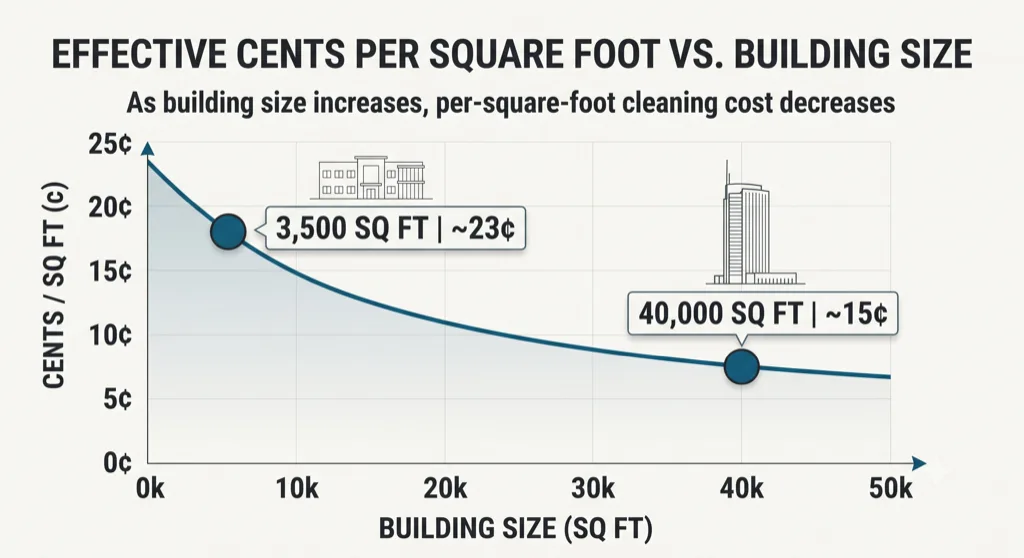
Commercial cleaning rates per square foot run roughly $0.05 to $0.25 per month for standard recurring work, and the moment you treat that band as a quote, you start losing money on small buildings. Trade-association surveys from groups like BSCAI and ISSA report that range, and it's real enough as a sanity check. What it hides is the curve underneath it: the per-foot rate isn't flat across building sizes. It climbs, sharply, as the building gets smaller, because a big share of every visit has nothing to do with square footage at all.
I learned this on a 3,500-square-foot medical office. I priced it at the same per-foot rate I use for my 20,000-footers, because that's the rate I had in my head, and a foot is a foot. Four months later the account was underwater. Nothing was wrong with the crew or the building. The rate was wrong, in a way the per-foot number is designed to hide. I run ProCleanings in New York and Verdant in Texas, and I've made this mistake in both.
The per-square-foot rate falls as the building grows, because fixed per-visit time gets diluted across more floor. Quote a small building at a big building's rate and you've signed up to lose money on day one.
What are the real commercial cleaning rates per square foot?
Standard recurring commercial cleaning generally runs $0.05 to $0.25 per square foot per month, with medical and high-fixture spaces climbing past $0.30, but the band is a starting range, not a price.
Those numbers come from trade-association surveys. The National Cleaning Authority attributes a common band of $0.05 to $0.25 per square foot per month to BSCAI and ISSA survey data, varying by frequency, building type, and regional labor cost.
Treat it as a guardrail. If your number lands at three cents or forty, something's off. But office cleaning prices per sq ft span more than a 4x spread from bottom to top, and no single figure inside it is "the rate." The spread exists because what actually drives cost — wages, production rate, fixture count, frequency, fixed visit time — varies enormously building to building. The average just flattens it into one comfortable number.
Why is small-building cleaning more expensive per square foot?
Because part of every visit is fixed, and small building cleaning pricing has to carry that fixed time across less floor.
Think about what a cleaner does on a visit. Some scales with the floor: vacuuming, mopping, wiping, emptying. But a real block of time doesn't scale at all. Driving to the site and back. Loading and unloading the cart. Staging supplies. The alarm, the keys, the lockup at the end. Whether the building's 3,500 square feet or 40,000, that block's roughly the same forty-odd minutes, and it's the hidden driver of your cleaning cost per square foot.
Watch what that does to the math. On a 3,500-square-foot office, that fixed block's about a third of the visit. On a 20,000-square-foot building, it's under a tenth. The cleaning per foot costs the same on both. The overhead per foot is nearly four times heavier on the small one. That's not inefficiency. It's arithmetic, and it's why the per-foot rate rises as the building shrinks.
This is why job-costing guidance from BSCAI's bidding and estimating series insists you cost the whole job — labor, materials, overhead — not reach for a per-foot shortcut. Industry benchmarking puts field labor at roughly 85 to 90 percent of janitorial cost, which is why time discipline, not the headline rate, decides whether a contract makes money.
What does the per-foot rate actually look like by building size?
Hold everything constant except size, and the effective rate falls from the high twenties to the mid-teens in cents per foot as the building grows.
Here's the curve, built from labor math rather than a survey. These figures are illustration, not a rate card: one crew, a production rate of 3,000 square feet an hour, a burdened wage inside the current BLS range for janitors, forty minutes of fixed time per visit, three visits a week. Change the assumptions and the numbers move. The shape doesn't.
| Building size | Fixed time as share of visit | Effective monthly cost | Effective rate |
|---|---|---|---|
| 3,500 sq ft | 36% | $636 | 22.7¢/sq ft |
| 5,000 sq ft | 29% | $814 | 20.3¢/sq ft |
| 10,000 sq ft | 17% | $1,405 | 17.6¢/sq ft |
| 20,000 sq ft | 9% | $2,588 | 16.2¢/sq ft |
| 40,000 sq ft | 5% | $4,953 | 15.5¢/sq ft |
The 3,500-foot building costs 22.7 cents a foot. The 20,000-footer costs 16.2. Same people, same speed, same wage. The small one's more than 1.4 times the large one per foot, and every cent of that gap is fixed time you can't cut.
So picture my mistake. Take the 20,000-footer's rate, 16.2 cents, and apply it to the 3,500-foot job. You bill about $566 a month. The job costs $636 to run. That's not a thin margin — it's losing $70 a month, every month, on a contract you were happy to win. The commercial cleaning cost calculator ProTeams put out is a free way to run your own square footage and wage through the same math before you quote.
How should you actually price per square foot?
You don't price per square foot. You cost the job in hours, add your margin, and let the per-foot number fall out at the end as a check.
The order matters. Start with cleanable square footage, divide by your measured production rate for the cleaning hours, and add the fixed per-visit time this building demands. Multiply by your burdened wage. Add supplies and overhead. Divide by one minus your margin. Then divide that monthly price by the square footage and check the cents-per-foot against the published band. That's worth more than any commercial cleaning price list you'll find online, because it's built on your crew, not somebody's average.
That's the same argument I made about why per-square-foot pricing is an output, not an input. The per-foot rate is a receipt for a costing decision, not the decision itself. Small buildings are where borrowing the rate hurts most, because that's where the fixed-time distortion is largest, but the principle holds at every size.
The piece most operators can't produce on demand is their own production rate and fixed-time figure. That's a measurement problem, not a pricing one. If you don't know how long your crew actually spends on a comparable building, setup time included, you're guessing at the two inputs that swing the answer hardest — the same two inputs covered in measuring your own janitorial production rates.
Frequently Asked Questions
What is the average cost per square foot for commercial cleaning?
Trade-association surveys put standard recurring commercial cleaning between about $0.05 and $0.25 per square foot per month, depending on building type, frequency, and local wages; medical and high-fixture spaces run higher. But an average hides what decides your margin: the same per-foot rate that works on a 20,000-square-foot building loses money on a 3,500-square-foot one, because fixed time doesn't shrink with the floor.
Why is small-building cleaning more expensive per square foot?
Because a chunk of every visit has nothing to do with square footage. Drive time, loading and unloading the cart, staging supplies, the alarm, the keys, the lockup. That block is roughly the same whether the building is 3,500 feet or 40,000. On a small job it can be a third of the visit; on a large one it's under a tenth. Spread the same fixed minutes over fewer feet and the per-foot cost climbs.
Is there a standard price per square foot I can quote from?
No single number holds across building sizes and types. The published ranges are a sanity check, not a quote. Price from your own labor: cleanable square footage over your measured production rate for hours, plus fixed per-visit time, times your burdened wage, plus supplies and overhead, divided by one minus your margin. The per-foot figure falls out at the end.
How much does it cost to clean a small office?
For a small office in the 2,000 to 5,000 square foot range on a few visits a week, expect the effective rate to land higher per foot than the headline average, often in the low-to-mid twenty-cent range or above, even though the monthly dollar figure is small. The building isn't expensive; the per-foot math just stops flattering you once fixed time is a big share of each visit.
The rate is a receipt
Every per-foot number you've seen quoted is the end of somebody's arithmetic, not the start of yours. On a big building, borrowing it might not hurt much. On a small one, it's how you end up paying a client for the privilege of cleaning their office. Measure your own hours, cost the whole visit, and let the cents-per-foot be the last thing you calculate.
Then it's a number you can defend. Not a number you hope is close.
Price from what your crews actually do
The rate that protects your margin is the one built on your real hours, on this building, with this crew. That starts with knowing when the shift began and when it ended, on every site, without chasing anyone for the number.
ProTeams.io helps commercial cleaning companies centralize the systems that keep field operations moving:
- Crew scheduling and shift check-ins
- Field communication between office staff, supervisors, and cleaners
- Issue tracking and service requests
- Attendance visibility and field accountability
- Checklists and task completion follow-up
- Operational reporting across clients and locations
Get the hours on record, and your next per-foot quote stands on something real.