
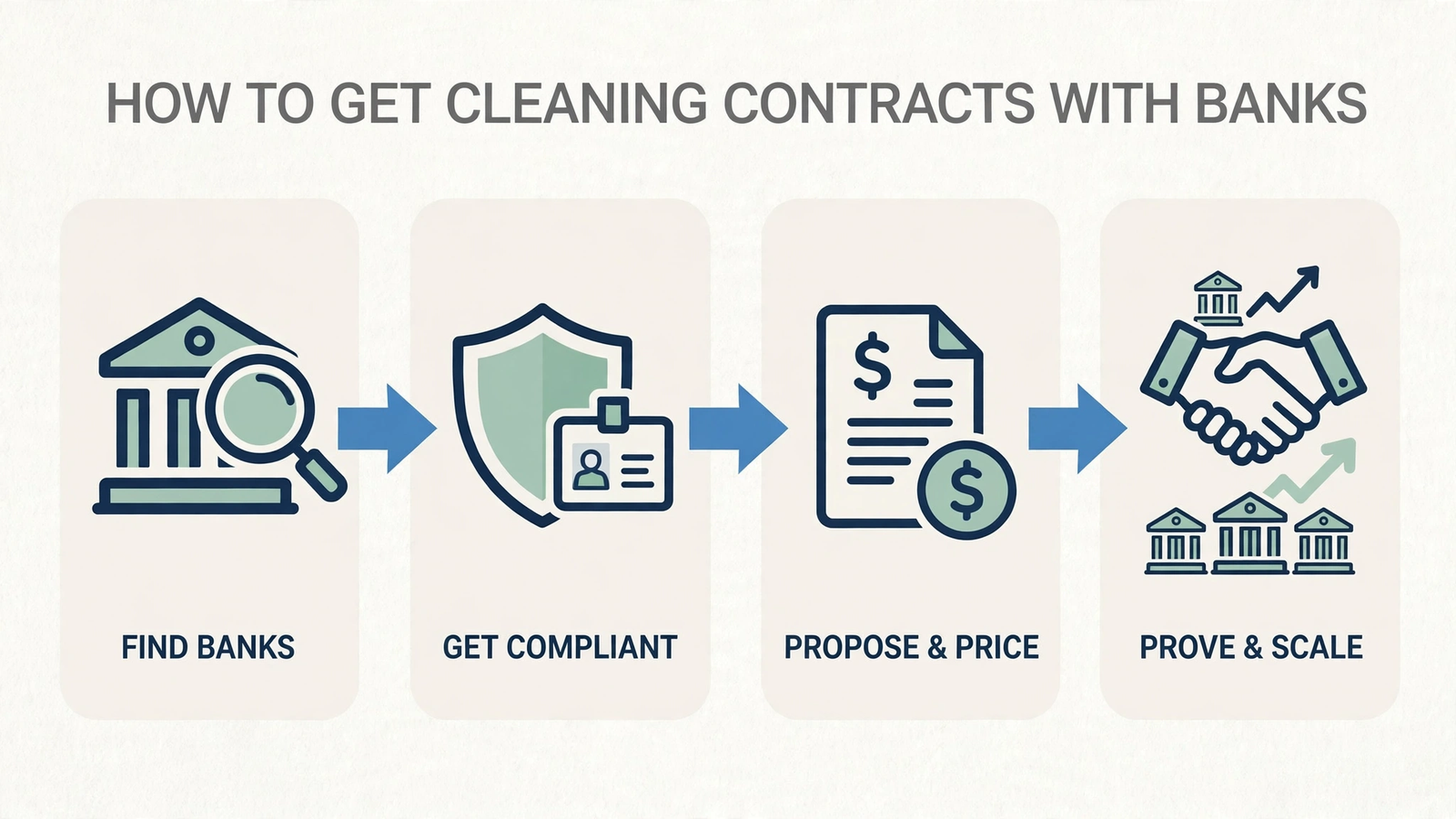
Bank cleaning contracts are won by proving three things before you clean a single branch: your staff's vetted, your access is controlled and documented, and you can show a record of every visit. Banks run cleaning vendors through their third-party risk process, so the winning bid usually makes that review easy. Get the compliance paperwork right and multi-branch work becomes some of the steadiest revenue you'll have.
I've worked through enough bank contracts on the support and coordination side to know the first RFP usually shows operators they prepared for the wrong test. A strong scope and a sharp price get you into the conversation. Then the vendor management team asks who holds your keys, how you screen every cleaner, and how the bank would know a crew had been inside at 11 p.m. Those answers have to be ready before the bid goes in.
Banks buy cleaning on trust they can verify: vetted staff, controlled access, and a documented record of every visit. Prepare those before the RFP and your scope and price'll get a fair read.
Why are bank cleaning contracts worth pursuing?
Bank work is worth the extra paperwork because it tends to be multi-branch, recurring, and sticky: once a bank has vetted a vendor, it has good reason not to start over.
A branch network repeats the same scope across many sites, which makes staffing, supplies, and scheduling predictable. And the onboarding that feels like a hurdle works in your favor once you're through it: every new vendor means another round of due diligence for the bank, so a reliable company that already passed is the easy pick at renewal.
The compliance work adds real cost, so price it in. Labor's still the biggest line: the U.S. Bureau of Labor Statistics puts the national median wage for building cleaning workers at $17.56 an hour (OEWS, May 2025). Your fully loaded cost sits above that, and on bank work the vetting and documentation time belongs in the bid too.
What compliance requirements do bank cleaning contracts add?
Banks add six layers standard office work usually doesn't: vendor due diligence, staff background checks, controlled access, documented entry, restricted areas, and confidentiality. Together they make up the compliance stack you'll be checked against.
The reason sits with the regulators. In June 2023 the FDIC, the Federal Reserve, and the OCC issued joint guidance on third-party relationships covering due diligence, contract negotiation, and ongoing monitoring of the companies banks hire. It's risk-based, so a cleaning vendor usually gets a lighter review than a technology provider, but the bank still needs to show it knew who it hired and kept watch.
| Layer | What the bank checks | What to have ready |
|---|---|---|
| 1. Vendor due diligence | Who you are, whether you're insured, and whether you're stable enough to rely on. | Certificates of insurance, workers' comp, business documents, and references from comparable sites. |
| 2. Background checks | Whether every cleaner has been screened. Some banks accept a standard criminal check; others require fingerprint-based screening. | A written background check policy and a cleared record for every employee assigned to the account. |
| 3. Controlled access | Who holds keys, badges, and alarm codes, and how they're issued and taken back. | A custody log tied to named staff and a same-day process for removing anyone who leaves. |
| 4. Documented entry | Who entered each branch, when, and for how long. | Timestamped check-in and check-out records for every visit, by person and branch. |
| 5. Restricted areas | That vaults, cash-handling rooms, and server rooms stay off-limits, or are entered only with bank staff present. | Exclusion zones written into the scope, and crews trained on where they don't go. |
| 6. Confidentiality | That documents, screens, and shred bins aren't touched or read. | A signed confidentiality agreement and a clear "don't handle paper" rule in training. |
Treat that table as your checklist before the first bank RFP. Requirements vary by bank, so confirm each line with the facilities or vendor management team.
Who makes the vendor decision at a bank?
At a bank, the cleaning decision usually involves a facilities lead for the branches, corporate real estate for headquarters and large offices, and a vendor management or procurement team that runs the onboarding review.
A regional facilities manager typically owns the branch standard and recommends the vendor. Headquarters often sits under corporate real estate. Then there's vendor management or procurement, which runs the due diligence and can stall a deal the facilities manager already wants. Approval thresholds differ by bank, so ask early who signs.
One wrinkle: many larger banks outsource facilities to a commercial real estate or facilities firm. Then that firm may be your real buyer, and its approved-vendor list matters more than a contact at the bank.
How do you find bank cleaning contracts?
You find bank cleaning contracts through the bank's facilities or corporate real estate team, the firms that manage bank branch portfolios, larger contractors that hold multi-branch agreements, and local community banks and credit unions.
If you're working out how to get cleaning contracts with banks for the first time, start local. Community banks and credit unions often hire directly, and a well-run account becomes the reference a regional bank will ask for. For larger banks, look for supplier registration on the bank's site and find out who manages its branches. Subcontracting is the third door: national contractors holding bank master service agreements often need regional partners, which is how a 15-person company gets multi-branch bank experience.
The wider set of channels is covered in the playbook on how to get commercial cleaning contracts.
Building your first bank bid? Start from the free commercial cleaning proposal template and add a compliance section built from the table above.
What should your bank RFP response include?
A bank RFP response should put compliance ahead of price: a compliance section, your background check policy, your access-control process, proof-of-service capability, and an after-hours supervision plan.
Picture the bid. A regional bank wants one vendor for 12 branches of roughly 4,000 square feet each, cleaned after close, spread across a two-hour drive. Vendor management reads your compliance section first. The facilities manager reads your supervision plan next, because the real question is how you'll know what's happening at 12 empty branches at night.
Answer it directly. Show who supervises which branches, how a missed visit gets caught the same night, and what record the bank receives afterward, with a sample attached. If you're working out how to get bank cleaning contracts against larger competitors, a supervision plan with evidence behind it lets a smaller operator stand out.
How does ProTeams help you win and keep bank contracts?
ProTeams gives you the visit records and after-hours oversight banks ask about: timestamped check-ins, photo proof of service, no-show alerts, and real-time visibility across every branch.
Every check-in and check-out's timestamped by person and site, which covers layer four of the stack. On the Growth and Scale plans, GPS check-in uses a geofence to confirm the cleaner was actually at the branch; on Launch, check-ins are geo-tagged. Proof of service software adds photos of completed work, marked verified when they're taken on-site. Real-time visibility and no-show alerts mean you'll see all 12 branches at night without a manager driving between them. And on Growth and Scale, reports go to the bank's facilities team automatically each week, month, or quarter.
The boundary: ProTeams doesn't run background checks, manage keys, or replace the bank's vendor review. It gives you records to hand over when the bank asks, and alerts to fix a problem before they'd need to.
Frequently Asked Questions
How do I get a cleaning contract with a bank?
Start with a community bank or credit union, or subcontract for a larger company that already cleans bank branches, to build a bank reference. Then prepare the compliance pieces banks check: insurance, a background check policy, an access-control process, and timestamped records of every visit. Find the bank's facilities or corporate real estate contact, or the firm managing its branches, and lead your proposal with compliance before price.
What background checks do banks require for cleaning staff?
It depends on the bank. Some accept a standard criminal background check for every cleaner assigned to their branches; others require fingerprint-based screening, especially for staff with keys or after-hours access. Ask during the RFP what level they need, keep a written policy, and keep a cleared record for each employee on the account so you can produce it when the bank's vendor management team asks.
How much do bank cleaning contracts pay?
There's no standard rate, because pay depends on branch size, frequency, scope, and local labor costs, plus the extra cost of compliance. Labor is the biggest factor: the national median wage for building cleaning workers is $17.56 an hour, per the Bureau of Labor Statistics (May 2025). Build your price from estimated hours and your fully loaded labor cost, then add the vetting, supervision, and documentation time bank work requires.
Can cleaning staff enter a bank vault?
Usually not. Vaults, cash-handling rooms, and often server rooms are excluded from cleaning scope, or entered only with bank staff present. Write those exclusion zones into your scope, train crews on exactly where they don't go, and confirm the rules with each branch. A clear answer here's one of the fastest ways to earn a facilities team's trust.
Make the bank's vendor review easy
The operator who wins bank work arrives with the compliance stack already built: vetted staff, controlled keys, written exclusion zones, and a record of every visit. You can build all of it before you ever see an RFP, and once it's built, a 15-person company can compete for branch networks. When you're ready to show a bank that kind of record, start your free trial or book a demo.
Give banks the records they need to say yes
ProTeams logs every check-in by person and branch, flags missed visits the same night, and sends reports to the facilities team automatically — the evidence stack that turns a first bank bid into a renewed contract.