
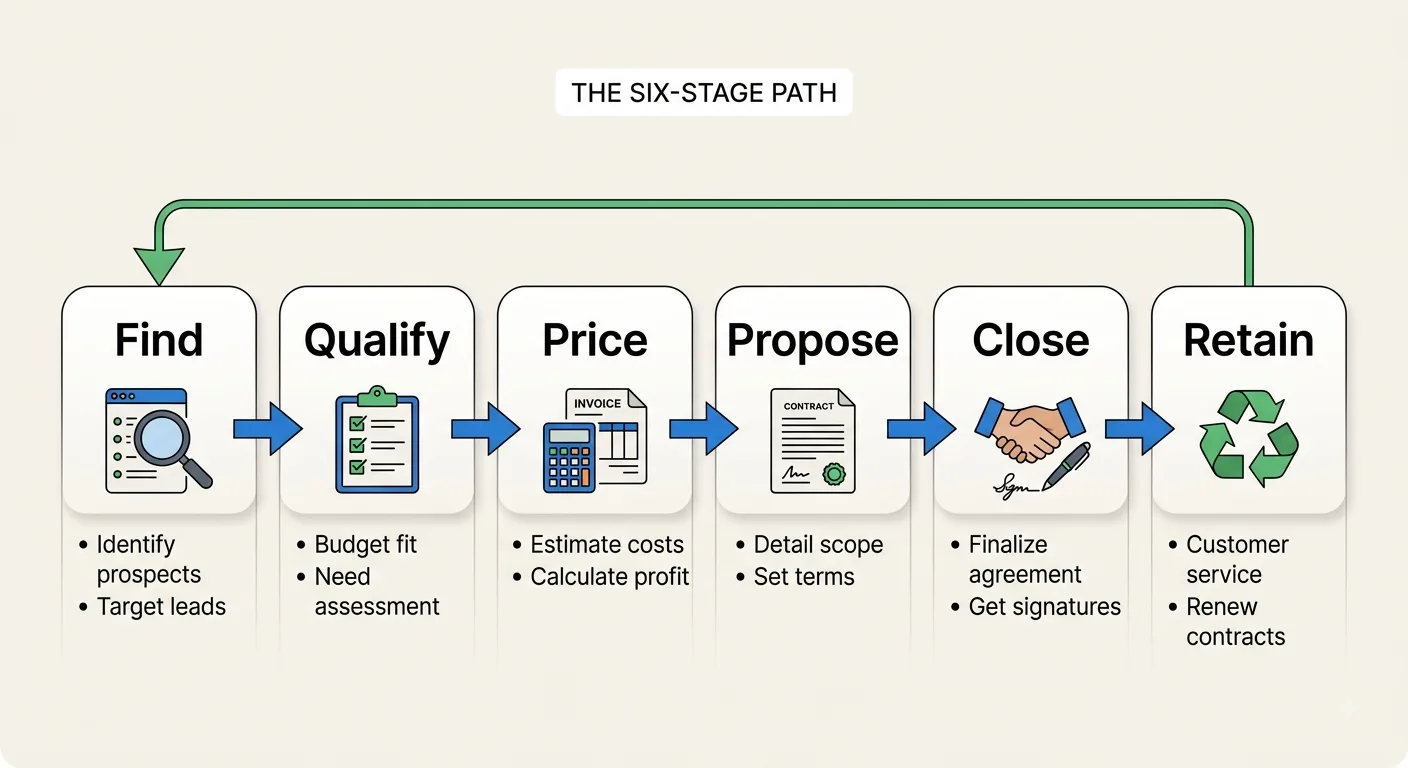
Commercial cleaning contracts are recurring or project agreements to clean offices, government buildings, banks, schools, medical sites, and other non-residential properties. You get them by working four stages in order: find the opportunity, win the bid, sign a contract that protects you, and keep the account by proving the work gets done. Most operators are strong at one or two stages and lose work at the others. This playbook covers all four, and each section links to a deeper guide for that stage.
I run operations at Verdant Building Service in Texas, which means I'm the one who staffs every contract we win and absorbs every one we lose. For years our pipeline was referrals. Then we watched two accounts go to competitors who'd bid on RFPs we never knew existed, and a third walk because we couldn't show the client proof of what our crew did at 2 a.m. None of those losses were about the quality of our cleaning. They were about the system around it. If you've searched how to get cleaning contracts and found a list of tips with no order to them, this is the order.
Winning commercial cleaning contracts is a four-stage system: find, win, sign, keep. Referrals fill one stage for a while. A repeatable system fills all four.
What types of commercial cleaning contracts exist?
Commercial cleaning contracts fall into six common types: recurring janitorial, project-based, government, bank and financial, school and education, and medical or specialty. Each is found, bid, and kept a little differently.
Recurring janitorial is scheduled cleaning of offices, retail, and industrial space, billed monthly on a term contract. It's the base most operators build on.
Project-based work covers one-off or periodic jobs like post-construction cleanup, floor stripping, and carpet extraction.
Government contracts are cleaning agreements for federal, state, county, and municipal buildings, awarded through formal procurement.
Bank and financial contracts cover branches and offices where security procedures shape who can clean, and when.
School and education contracts cover districts and campuses, often through public bids with background-check requirements.
Medical and specialty contracts cover clinics and other sites where infection-control standards raise the bar on training and documentation.
Knowing which type you're chasing matters, because it decides where you look, what you'll need on paper, and how the buyer will judge you. A 20-person company can do well in several of these, but rarely all six at once. Pick the two that match your crews and references, and build from there. That focus is most of the answer to how to get contracts for cleaning business growth: every type you add brings its own paperwork, buyers, and standards, so add them one at a time, after the first ones are running smoothly.
How do you find commercial cleaning contracts?
You find commercial cleaning contracts through five channels: bid boards, property managers, government portals, industry networking, and direct outreach to facility managers. Referrals still close best, but they don't scale when you need them to.
Each channel fits a different kind of work. Bid boards and RFP aggregators collect private solicitations, though you'll want to screen out the lead-resale sites that recycle stale listings. Property management companies are the strongest private channel, because one manager often controls cleaning for a dozen buildings. Government portals, starting with SAM.gov for federal work and state and county procurement sites for local work, post public cleaning contracts openly. Industry networking through groups like ISSA and BSCAI chapters puts you in the room with the managers and larger contractors who award and subcontract work. And direct outreach means walking buildings you want, finding the facility manager, and making a specific, prepared approach.
The mistake is working all five at once. A small crew with no government registration should start with property managers and direct outreach, build references, then add the formal channels. Whatever mix you choose, track where every lead came from and which ones closed. After two quarters you'll know which channels actually produce signed work for your company, and you can put your time there instead of spreading it evenly. The full breakdown, including which channel fits which company size, is in the guide on where to find commercial cleaning contracts.
How do you win office cleaning contracts?
You win office cleaning contracts by walking the building before you price it, getting a clear, specific proposal back quickly, and having your insurance and compliance documents ready before anyone asks.
Offices are the most common commercial account and the most competitive, so the details decide it. The walkthrough is where you find the hour drivers a square-footage number hides: restroom count, floor mix, furniture density, freight-elevator waits. Speed matters next. A complete proposal that lands a day or two after the walk reads as a company that'll be just as responsive once it's cleaning the building. And compliance isn't a step you do at the end; a facility manager comparing three bids will set aside the one missing a certificate of insurance before reading its scope.
If you need a structure for the proposal itself, the free commercial cleaning proposal template gives you the scope tables, frequency schedule, and terms. The full guide is in how to win office cleaning contracts.
How do you win government cleaning contracts?
You win government cleaning contracts by registering first (SAM.gov for federal work, separate portals for state and local), reading how the solicitation will be evaluated, and building your proposal to answer exactly those factors.
Government work is large, stable, and pays reliably, and the paperwork keeps a lot of competitors away. Federal registration on SAM.gov is free and takes roughly two weeks to clear, so it has to happen before you find the contract you want. The step most operators miss comes next: every solicitation states how bids will be judged. Some award to the lowest price that meets the minimum requirements. Others weigh technical approach and past performance against price and can pay more for a stronger bid. The weights change from one solicitation to the next, so read the evaluation section first and write to it.
For a first government contract, start local. City, county, and school-district bids carry lighter requirements and smaller fields than federal work. The full process, from registration to scoring to the proposal, is in the guide on how to win government cleaning contracts.
How do you win bank cleaning contracts?
You win bank cleaning contracts by showing you can meet their security procedures, work reliably after hours, and manage several branches to the same standard.
Banks buy cleaning differently from a typical office. Security comes first: expect background checks for every cleaner, strict rules around keys and alarm codes, and areas your crew won't enter at all. Most of the work happens after hours, when the branch is empty, so the bank has to trust a crew it never sees. And many contracts cover multiple branches, which means the buyer is judging whether you can hold one standard across ten locations rather than one.
That combination rewards operators who can document everything: who entered which branch, when, and what they did. A bank's facilities or security team will ask how you'd prove a clean happened and who was on-site, and the operator with a real answer wins. The full guide is in how to get cleaning contracts with banks.
What should every commercial cleaning contract include?
Every commercial cleaning contract should include a scope of work by area, service frequency, pricing and payment terms, a change-order clause, termination notice, insurance requirements, and a list of what's excluded.
The proposal wins the account; the contract decides what happens when something changes. Two clauses carry most of the weight. The scope of work, broken out by area with task and frequency, defines exactly what you're on the hook for. The change-order clause says any added work needs written approval and gets billed at your stated rate before it starts, which is what stops a client from adding two restrooms and a break room to the "agreed" scope for free. Termination notice protects both sides, and the excluded-services list closes the gaps where "I thought that was included" arguments start.
We've covered every clause in detail in what every cleaning contract must include — use the 10-clause checklist there to audit your current contract. It's operational guidance, not legal advice, so have an attorney review the final document.
Pricing and proposals come before the contract. Build your number with the free commercial cleaning calculator, then lay it out with the proposal template above. Both are free and don't need an account.
What do facility managers actually evaluate in a cleaning bid?
Facility managers evaluate a cleaning bid as a risk decision: they're choosing the company least likely to leave them with an empty building, an angry tenant, and a vendor they have to defend to their own boss. Price matters, but only among bids that clear the risk test first.
Almost every guide to cleaning contracts is written from the contractor's side. It's worth flipping the view, because the person reading your bid is asking a different question from the one you're answering. You're asking how to win. They're asking what happens to them if they pick you and you fail. Answer that question and the rest of the proposal gets easier.
Here's what they're weighing, roughly in the order it moves the decision. Use it as a checklist before you submit anything.
| What they're checking | What they need to see |
|---|---|
| 1. Will your crew actually show up? | A clear answer to how you catch a missed shift before tenants notice, and who covers it. |
| 2. Can you prove the work happened? | Timestamped records and photos of completed work, available on request. |
| 3. Are you a liability risk? | Certificates of insurance and workers' comp, attached before anyone asks. |
| 4. Did you understand the building? | A scope broken out by area and frequency that proves you walked it. |
| 5. Has anyone like me trusted you? | References from comparable buildings they can actually call. |
| 6. Will you make me look good? | Reports and records they can show their own boss without chasing you. |
Look at where price sits in that list. It doesn't. A facility manager who's been burned by a no-show vendor will pay more for the bid that removes the risk, because the cost of a bad choice lands on them personally. Items one, two, and six are where most small operators leave points on the table, and they're also the items a written promise can't satisfy. "We're reliable" is a claim. A sample report showing timestamped check-ins and photo proof from a current account is evidence.
Picture how this plays out. Two companies bid a 30,000-square-foot office building cleaned five nights a week. The first bid comes in slightly lower and says the crew is experienced and dependable. The second is a little higher and includes a one-page sample of the monthly report the client would receive: check-in times, completed tasks, photos. The facility manager has lived through a vendor who stopped showing up and nobody noticed for a week. She picks the second bid, and the price difference never comes up.
Build your proposal around this scorecard, in this order, and you'll be answering the buyer's actual question instead of the one you assumed they were asking. Before you submit, go down the six rows and ask whether your bid shows the evidence or just makes the claim. Any row where you're relying on a promise is a row a competitor can win.
How do you keep a commercial cleaning contract once you've won it?
You keep a commercial cleaning contract by removing doubt before it forms: prove every visit, surface problems before the client finds them, and give the client a way to see the work for themselves.
Winning an account is expensive; keeping one is cheap by comparison, and most operators underinvest in exactly the stage with the best return. Accounts are rarely lost on cleaning quality alone. They're lost on the client's uncertainty about quality, and that uncertainty grows every week you can't show them what happened. Timestamped proof of service software answers "did you actually clean it?" before the client asks. A client portal lets them check schedules and report issues without calling you. And regular reports turn a year of reliable work into evidence at renewal time, so you're presenting a record instead of defending a price.
ProTeams covers this stage. It handles scheduling, proof of service with photos marked verified when they're taken on-site, no-show alerts, real-time visibility, and a client portal. Reports delivered to clients automatically are on the Growth and Scale plans, as is geofenced check-in. It doesn't write proposals, calculate bids, or handle invoicing and payroll; the free tools above and your accounting software cover those. For how the software side fits together, see the guide to commercial cleaning business software. A full guide to keeping accounts is coming as the last spoke in this series.
Frequently Asked Questions
How do I get my first commercial cleaning contract?
Start with a small recurring account you can service well, like a single office, a clinic, or a place of worship. Get general liability and workers' comp insurance in place first, because you can't credibly bid without it. Then approach the facility manager or owner directly with a walkthrough and a clear proposal rather than waiting for a formal bid. Win that one, document the work carefully, and use it as the reference for your next account.
Where can I find commercial cleaning contracts to bid on?
Look in five places: property management companies that oversee several buildings, facility managers you approach directly, government portals like SAM.gov and state and county procurement sites, private bid boards and RFP aggregators, and industry groups like ISSA and BSCAI. Referrals from happy clients still close best, but they don't arrive on demand, so build at least two of the other channels.
What do facility managers look for in a cleaning company?
They're judging risk more than price. They want to know your crew will show up and that you'll catch a missed shift before tenants do, that you can prove the work happened, that your insurance is in order, that you understood their building, that someone like them has trusted you before, and that you'll give them records they can show their own boss. Price decides it only among the bids that pass those tests.
How much do commercial cleaning contracts pay?
It depends on the building's size, how often it's cleaned, the scope, and your local labor costs, so there's no single rate worth quoting. Labor is the biggest cost: the Bureau of Labor Statistics puts the national median wage for building cleaning workers at $17.56 an hour (OEWS, May 2025). The reliable way to price a contract is to estimate the hours the work takes, apply your fully loaded labor cost, add supplies, overhead, and margin, then check the result against local market rates.
What is the difference between a cleaning contract and a proposal?
A proposal is the sales document you send to win the work: your scope, price, approach, and reasons to choose you. A contract is the binding agreement you both sign after they say yes, covering obligations, term, payment, changes, and how either side can exit. The proposal wins the account and the contract governs it. A strong proposal often becomes the backbone of the contract.
Build all four stages, not just the one you're good at
Referrals feel like a strategy right up until three accounts cancel in the same year. The operators who keep growing past that point run all four stages on purpose: they know where to look, they bid the way buyers actually judge, they sign contracts that hold up when scope changes, and they prove the work every night so nobody has a reason to shop the account. You don't have to fix all four this month. Find the stage where you're losing work, fix that one, then the next. If keeping accounts is where you're weakest, see how ProTeams handles proof of service and client visibility: start your free trial or book a demo.
Win the contract, then prove you earned it every night
The bid gets you the account. Keeping it takes evidence the work happened, in a building the client never sees, night after night. That's the part most operators can't show, and it's the part that turns a won contract into a renewed one.
Related reading
- How to Write a Commercial Cleaning Bid Proposal (Template + Examples)
- Cleaning Contract Pricing: Why Per-Square-Foot Is the Wrong Place to Start
- Government Cleaning Contract Requirements: Insurance, Bonds, Prevailing Wage, and Compliance
- How to Register on SAM.gov as a Cleaning Contractor
- What Every Commercial Cleaning Contract Must Include: A 10-Clause Checklist
- How to Keep a Commercial Cleaning Contract