
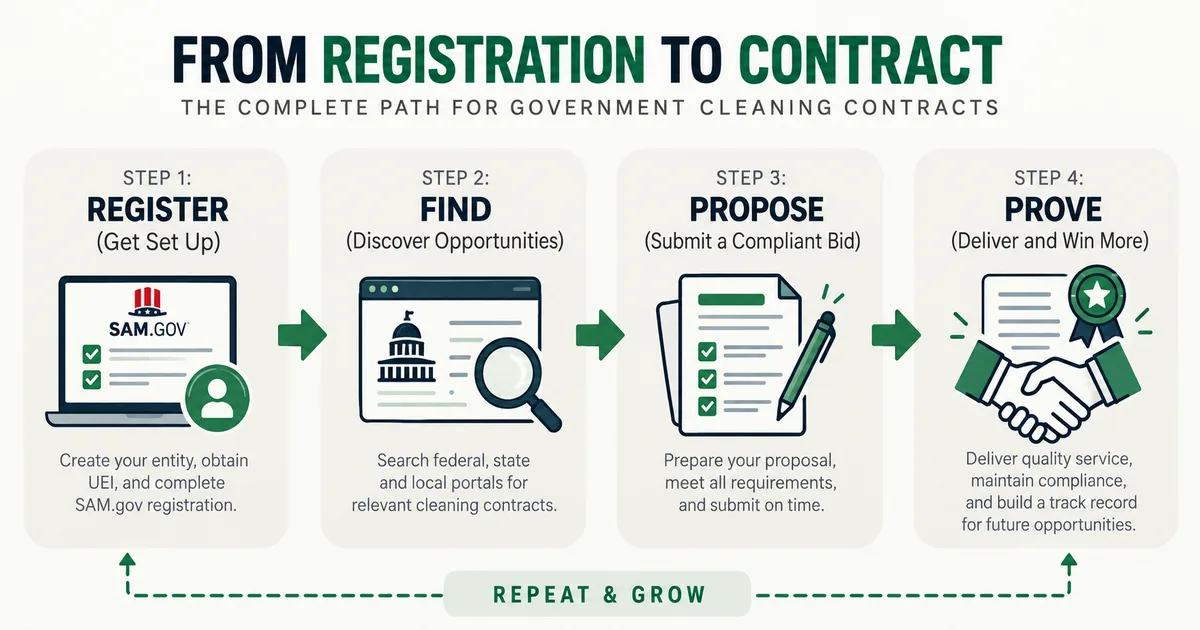
To register on SAM.gov as a cleaning contractor, you create a Login.gov account, request your free Unique Entity Identifier, and complete entity registration with your business details and NAICS codes — 561720 for janitorial services as your primary. It's free, takes an hour or two, and about 10 to 15 business days to approve. The process looks bureaucratic enough that a lot of operators close the tab the first time. It's more tedious than hard — walk through it once and that "Register to Bid" button stops being intimidating.
I manage operations at ProTeams and run day-to-day field ops at ProCleanings and Verdant Building Services, so I've watched operators stall on SAM.gov registration longer than the registration itself takes. Every field has a plain answer once someone shows you. A six-figure federal commercial cleaning software operation starts here — with ninety minutes of form-filling and a two-week wait. This is the walk-through, field by field, so you don't close the tab this time.
SAM.gov registration cleaning company owners face is free, takes about an hour to complete and two weeks to approve, and it's the gate to every federal contract — the difficulty is patience, not complexity. Here's every step.
What do you need before you start?
Before you open the form, gather your legal business name, EIN, physical address, banking details for electronic payment, and the NAICS codes that describe your cleaning work — having these ready turns a frustrating session into a smooth one.
Most of the pain is stopping mid-form to dig up a number. Have these ready first:
- Legal business name and physical address — exactly as they appear on your IRS records. This match matters more than anything else.
- EIN (Employer Identification Number) — your federal tax ID.
- Bank account information — routing and account numbers, since the government pays by electronic funds transfer.
- NAICS codes — the industry codes for your work (detailed below).
- An entity administrator — the person (probably you) who'll maintain the registration.
Gather those five and the form is straightforward. Skip this step and you'll get halfway through and have to save and come back — which is how registrations stall for weeks.
How to get a UEI number for your cleaning business
You request your Unique Entity Identifier (UEI) for free directly on SAM.gov — it replaced the old DUNS number in April 2022, so ignore any guide that tells you to get a DUNS.
This is the most out-of-date thing in older SAM.gov guides, so get it straight: the UEI is a 12-character identifier the government uses to track your business, and since April 2022 it's assigned directly by SAM.gov. You no longer request a DUNS number from a third party — that system's gone. If a guide or "registration service" tells you to start by getting a DUNS number, they're working from old information.
You request the UEI as part of registration on SAM.gov, at no cost. Once assigned, it's permanent and tied to your business — what your registration, contracts, and payments all reference. The system also assigns a CAGE code automatically for US entities, so that's one more acronym you don't chase down separately.
Which NAICS codes should a cleaning company select?
Select 561720 (Janitorial Services) as your primary NAICS code, and add related codes like 561790 and 561740 if they describe work you actually do.
Your SAM.gov NAICS code janitorial businesses use classifies your industry, and it's how federal cleaning opportunities match to your business — solicitations are tagged with the codes they want. Pick the wrong primary and the right work never finds you. For commercial cleaning:
| NAICS code | What it covers | Use it as |
|---|---|---|
| 561720 | Janitorial Services | Primary — the core cleaning code |
| 561790 | Other Services to Buildings and Dwellings | Secondary, if applicable |
| 561740 | Carpet and Upholstery Cleaning | Secondary, if you do this work |
561720 is your primary, full stop — it's the code federal janitorial solicitations are almost always tagged with. You can list multiple codes, so add every one that genuinely describes what you do, since each is another way for contracts to find you. Don't pad the list with work you don't do. Your primary code also sets your small-business size standard for set-aside eligibility — one more reason to get it right.
Once you're registered and winning federal work, the contract will require you to prove service was delivered. That's what proof of service is built for — or start your free trial or book a demo.
How do you complete the entity registration?
With your information gathered, the registration itself takes one or two hours online, then roughly 10 to 15 business days to approve — so start well before any bid deadline.
Federal contractor registration cleaning businesses complete runs through one long form: you'll enter your business details, confirm your UEI, select your NAICS codes, provide banking information for electronic payment, and designate your entity administrator. Budget one or two focused hours — it's long, but not hard when your documents are ready.
Then you wait, roughly 10 to 15 business days — and here's the mistake that causes the most heartbreak: your legal business name and address in SAM.gov must exactly match your IRS records. A mismatch — an abbreviation, an old address, "LLC" versus "L.L.C." — is the most common reason registrations get held up, and it can add weeks. Check that match before you submit. And never start registration the week a bid is due; get registered before you find the contract, not after. Finding those contracts is covered in where to find commercial cleaning contracts, which covers SAM.gov's opportunity search alongside the other channels.
How do you keep your registration active?
SAM.gov registration expires every 12 months, and a lapsed registration makes you ineligible to bid or be paid — so set a renewal reminder the day you're approved.
This is the step that quietly costs established contractors work. Registration isn't permanent — renew it annually, and if it lapses, you can't bid, and payments on existing contracts can be interrupted until you're active again. The renewal's simple — if you remember before the deadline.
The fix takes thirty seconds: the day you're approved, set a recurring reminder for 60 days before the annual expiration. That's your buffer to renew without a gap. I've seen operators lose a contract they were perfectly positioned for purely because their registration had quietly expired. Don't be that company.
Should you pursue small business certifications?
If you qualify, small-business set-aside certifications — 8(a), HUBZone, SDVOSB, or WOSB — open contracts reserved for a smaller field, and they're worth pursuing after your basic registration is done.
Basic registration lets you bid on open contracts. Certifications go further: the government reserves a large share of contracts for small businesses, and socioeconomic programs create pools with far less competition. The main ones are 8(a) (socially and economically disadvantaged owners), HUBZone (historically underutilized zones), SDVOSB (service-disabled veteran-owned), and WOSB (women-owned). If you qualify, it's one of the highest-return moves in government contracting — you're suddenly competing against a fraction of the field.
Certification is a separate process and takes more effort, so treat it as your next step after you're registered and active, not a prerequisite. The broader strategy of winning and keeping these contracts is in the pillar on how to bid on government cleaning contracts, and the compliance you'll face after award is in government cleaning contract requirements.
Frequently Asked Questions
How do I register on SAM.gov as a cleaning contractor?
Create a Login.gov account, request your Unique Entity Identifier (UEI) on SAM.gov, then complete full entity registration with your legal business name, EIN, physical address, banking details for electronic payment, and your NAICS codes. Cleaning companies select 561720 (janitorial services) as the primary code. Registration is free, takes one to two hours to fill out, and roughly 10 to 15 business days to be approved. If anyone charges you to register, they aren't the government — SAM.gov registration costs nothing.
What NAICS code should a cleaning company use on SAM.gov?
The primary NAICS code for commercial cleaning is 561720, Janitorial Services. Many operators also add 561790 (other services to buildings and dwellings) and, if they do carpet and upholstery work, 561740. Choose 561720 as your primary because federal cleaning solicitations are almost always tagged with it, and your primary code is how the right opportunities surface for you. You can list multiple codes, so add every one that genuinely describes work you do.
What is a UEI number and how do I get one?
A Unique Entity Identifier (UEI) is the 12-character ID the federal government uses to identify your business. It replaced the old DUNS number in April 2022, so any guide telling you to get a DUNS number is out of date. You request your UEI directly on SAM.gov for free as part of entity registration — you no longer go through a third party. Once assigned, the UEI stays with your business and is what contracts and payments are tied to.
The tab you closed is worth reopening
That "Register to Bid" button you clicked away from is ninety minutes and a two-week wait from making you eligible for a market most competitors never enter. Gather your five documents, request your free UEI, set 561720 as your primary code, match your business name to your IRS records exactly, and submit. Then set the renewal reminder so a lapse never costs you eligibility. It's not hard — just unfamiliar the first time, and done once it opens the door. The contract you spotted is still there. Go get registered, then go get it.
Registered and bidding? Prove every visit and keep the contract.
Getting on SAM.gov opens the door. Winning federal cleaning work — and keeping it — takes proof you delivered, because government contracts require documented, verifiable service. That's what turns a first award into a renewed one.
ProTeams.io helps commercial cleaning companies centralize the systems that keep field operations moving:
- Crew scheduling and shift check-ins
- Field communication between office staff, supervisors, and cleaners
- Issue tracking and service requests
- Attendance visibility and field accountability
- Checklists and task completion follow-up
- Operational reporting across clients and locations
Win the federal contract, then prove you delivered it, visit after visit.