
An office cleaning schedule is the list of what gets cleaned in an office and how often: restrooms, kitchens, and trash daily; full vacuuming and desk dusting two to three times a week; and deeper work like vents and carpet extraction monthly or quarterly. In most offices, restrooms and kitchens need service every night the office is used, and more than once a day past about 100 people. Headcount, more than square footage, decides the frequency. This guide's for both sides of the contract: the operator building the schedule and the facility manager deciding what to expect from a vendor.
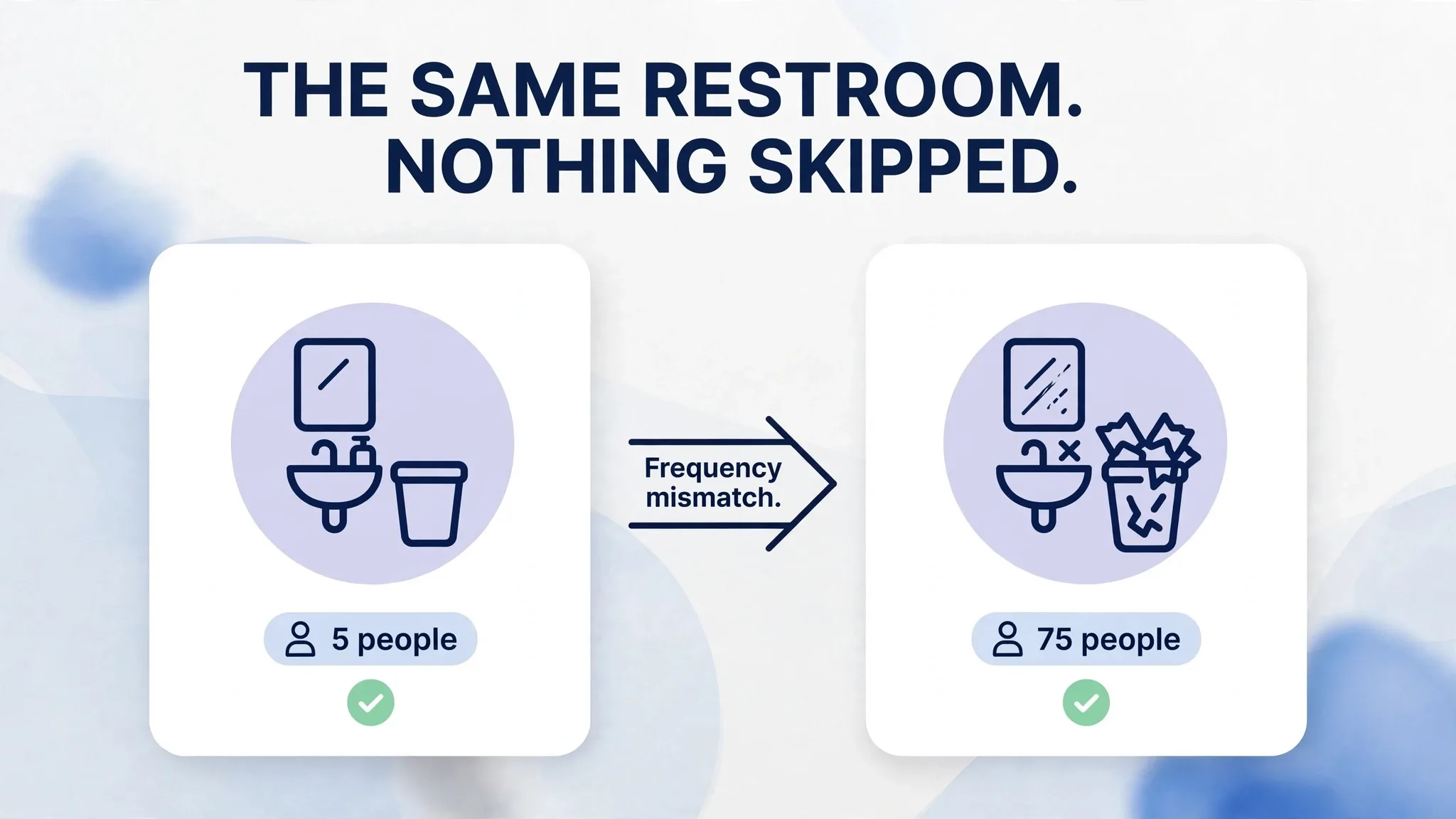
The complaint I hear most from facility managers at ProCleanings is about timing. The restrooms were spotless at 7 AM and rough by 2 PM. Nobody missed a task. The schedule just didn't match how many people were using the building.
Office cleaning frequency should follow how many people use the space each day. A nightly clean that's fine for 25 people falls apart at 150.
How often should an office be cleaned?
Most offices should be cleaned every night they're occupied, with restrooms, kitchens, trash, and entrances done daily. Offices above roughly 100 people usually need daytime restroom and kitchen service on top of the nightly clean.
"How often should an office be cleaned" has two answers: how often a crew comes in, and how often each task gets done. The crew usually comes five nights a week. The tasks vary. Restrooms are daily. Desks might be weekly. Carpet extraction might be twice a year.
The full task-by-area breakdown, for offices and other building types, is in the guide to the commercial cleaning schedule. This post's focus is offices specifically, and how headcount changes the numbers.
What should be cleaned in an office every day?
Every day, an office needs its restrooms cleaned and restocked, kitchen counters and sinks wiped, all trash emptied, entrances tidied, and main walkways vacuumed. They're the tasks people notice by mid-morning if they're skipped.
- Restrooms. Disinfect toilets, urinals, sinks, and counters. Restock paper and soap. Mop.
- Kitchens and break rooms. Wipe counters, tables, and sinks. Spot-clean appliance fronts. Empty trash. Mop.
- Trash and recycling. Every desk bin and every common bin.
- Conference rooms. Wipe tables, reset chairs, clear whiteboards if the client wants it.
- Entrances and walkways. Glass doors, mats, and main traffic lanes.
It's conference rooms that people forget most. They get booked back to back, and a sticky table at a 9 AM client meeting doesn't stay quiet for long.
What should be cleaned weekly and monthly?
Weekly, an office needs full vacuuming of private offices, dusting of desks and partitions, and wiping of phones and shared equipment. Monthly, it needs vents, baseboards, light fixtures, and interior glass.
Desks deserve a note. Most cleaning contracts dust clear desk surfaces only, and don't touch papers or personal items. Put that in writing. It'll prevent the "why didn't they clean my desk" email and the "who moved my files" email in the same sentence.
Quarterly or twice a year, add carpet extraction and hard-floor refinishing. They're jobs with their own crew and their own night.
How should an office cleaning schedule change with headcount?
As headcount rises, restrooms, kitchens, and trash need more frequent service, while vacuuming stays nightly. Past about 100 people, the nightly clean alone usually can't keep restrooms and kitchens presentable through the afternoon.
The numbers below are my working guide from supporting office accounts at ProCleanings, not an industry standard. Headcount's the number of people actually in the building that day, not the names on the lease.
| People in the office | Restroom service | Kitchen service | Trash pulls | Vacuuming |
|---|---|---|---|---|
| 25 | Nightly | Nightly | Nightly | Traffic lanes nightly; full 2x a week |
| 50 | Nightly | Nightly | Nightly | Traffic lanes nightly; full 3x a week |
| 100 | Nightly, plus one midday check and restock | Nightly, plus a wipe-down after lunch | Nightly, plus a midday kitchen pull | Open areas nightly |
| 250 | Nightly, plus 2–3 daytime checks | Nightly, plus daytime service after each meal period | Nightly, plus daytime pulls in kitchens and restrooms | Open areas nightly; private offices 3x a week |
Notice what scales and what doesn't. Vacuuming tracks floor area, so it barely moves. Restrooms, kitchens, and trash track people, so they climb fast. That's why the jump from 50 to 100 is where most offices need a day porter.
Here's the dispute that usually forces the change. A 120-person office runs on a nightly schedule. By 2 PM the restrooms are out of paper and the kitchen trash is overflowing, and the facility manager's on the phone. Adding a two-hour midday porter shift, five days a week, comes to 520 hours a year. At the May 2025 median of $17.71 an hour for janitors and building cleaners, per the Bureau of Labor Statistics, that's about $9,209 a year in wages before taxes and overhead. It's a real cost. It's also the fix, and quoting it before the complaint's much easier than after.
When should a hybrid office's cleaning schedule flex?
A hybrid office's schedule should flex when occupancy varies by day of the week. Heavier service on the busy days, lighter on the quiet ones, with the total matched to how the space is actually used.
If an office is full Tuesday through Thursday and half empty Monday and Friday, the headcount table applies day by day. A 200-person office on Wednesday might be a 60-person office on Friday. Setting up hybrid office cleaning schedules that follow occupancy is its own topic, and that post covers it in full.
How do you verify the cleaning schedule is actually followed?
Verify the schedule with three records: check-ins that show the crew arrived, task checklists that show what was done, and reports the client can see. Without them, "was the office cleaned last night?" is one person's word against another's.
For operators, this is how you'll win the dispute before it starts. In ProTeams, every check-in is timestamped, and location-confirmed check-in is on the Growth and Scale plans. The tasks for each shift appear on the cleaner's phone as a digital checklist, and each one is marked as completed on site or off site. Clients can log in to a portal to view schedules and report issues, and auto-delivered client reports are on the Growth and Scale plans.
For facility managers, here's what to ask a vendor. How will I know the crew showed up? Can I see which tasks were done? Can I report a problem without calling? A vendor who can answer all three with a screen, and doesn't need to promise, is running a real office janitorial schedule.
Spot inspections close the loop. A janitorial inspection checklist built from the same office cleaning checklist schedule means you're inspecting exactly what the client is paying for.
Who schedules the crews behind the cleaning schedule?
The task schedule says what gets cleaned. A separate crew schedule says who cleans it, when they're due, and whether they arrived. If they don't match, tasks fall between shifts.
When a midday porter gets added, or a hybrid office drops Friday service, the crew schedule's got to change with it. That side of the work's covered in the guide to cleaning scheduling software.
Frequently Asked Questions
How often should an office be cleaned?
Most offices should be cleaned every night they're occupied, with restrooms, kitchens, trash, and entrances done daily, full vacuuming two to three times a week, and deeper work monthly or quarterly. Offices above about 100 people usually need daytime restroom and kitchen service as well.
What is a typical office cleaning schedule?
A typical office cleaning schedule covers restrooms, kitchens, trash, conference rooms, and walkways nightly; full vacuuming and desk dusting two to three times a week; vents, baseboards, and interior glass monthly; and carpet extraction and floor refinishing quarterly or twice a year.
How many times a week should office restrooms be cleaned?
Office restrooms should be cleaned every day the office is occupied. That's usually five times a week. Offices with around 100 or more people in the building often add one or more daytime checks to restock supplies and spot-clean between nightly cleans.
When does an office need a day porter?
An office usually needs a day porter when restrooms, kitchens, or trash can't stay presentable from morning to evening on a nightly clean alone. That's often around 100 people in the building, or sooner in offices with heavy kitchen use or public visitors.
Match the schedule to the people in the building
An office cleaning schedule that ignores headcount looks fine on paper and won't survive mid-afternoon. Count the people, set restroom and kitchen frequency to match, and write the desk policy down. Then make sure every task can be checked. To see how ProTeams puts the schedule, the check-ins, and the client reports in one place, book a demo or start your free trial.