
How to cover a no-show cleaning shift comes down to one hour: confirm the miss in the first 15 minutes, reassign a replacement by minute 30, and have someone checked in on site, or the client informed, by minute 60. A no-show is a scheduled shift with no check-in by the end of your grace window. What you do in the hour after it decides whether the client ever knows. The steps are simple. Doing them at 9:40 PM, from your kitchen, without a plan, is what makes them hard. Your cleaning scheduling software can shorten that hour, but only if the plan exists first.
I've worked the support side of night crews at ProCleanings, and every operator I know has had this night. A three-floor office, a shift that starts at 9:30, and at 9:40 nobody's checked in. You've got about nine hours before the first tenant walks in at 7. That's plenty, as long as you don't spend the first two hoping.
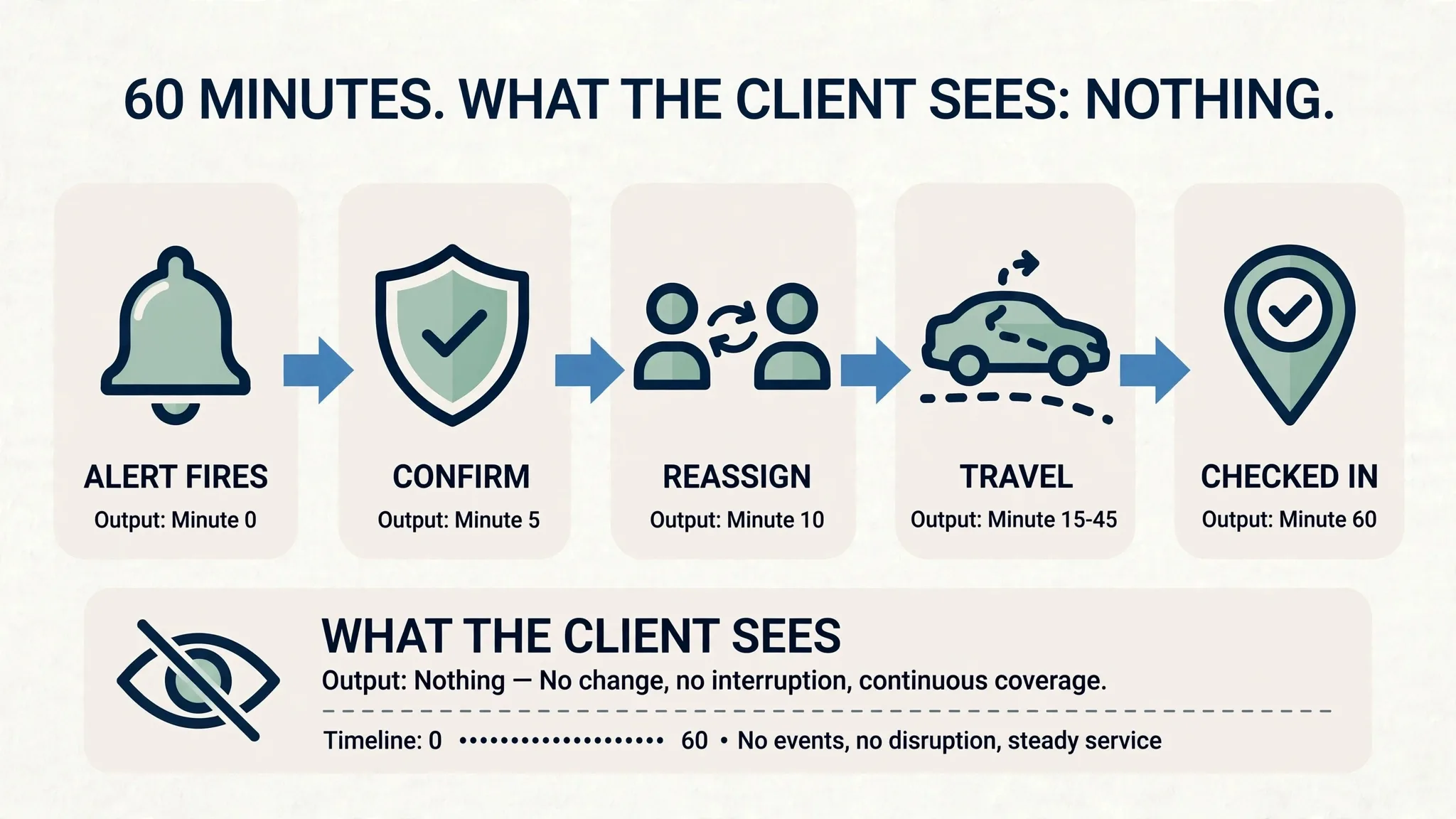
A no-show is a recovery problem with a 60-minute window. Confirm by 15, reassign by 30, and be covered or on the phone with the client by 60.
What counts as a no-show, and how is it different from late?
A cleaning crew no show is a scheduled shift with no check-in after your grace window has closed. Late means the cleaner checked in after the start time, or hasn't checked in yet but is still inside the window.
Set the grace window before you need it; ten to fifteen minutes is typical for night shifts in my experience. A cleaner who's eight minutes late and texted you is late. A cleaner who's silent at minute 15 is a no-show until proven otherwise.
A cleaning employee call out is the better version of the same problem: they told you in advance. Treat it the same way, only with a head start. Knowing a shift was missed is the job of no-show detection. This post is about what you do once you know.
What should happen in the first 60 minutes after a no-show?
In the first 60 minutes, confirm the cleaner isn't coming, reassign the shift from your bench, and get the replacement checked in on site. If you can't cover by minute 60, call the client before they find out on their own.
Here's the timeline I use, starting from the missed check-in. In the scenario above, minute 0 is 9:40 PM.
| Minute | Action | Who owns it | What the client sees |
|---|---|---|---|
| 0 | Grace window closes with no check-in. The alert fires. | On-call supervisor | Nothing. |
| 0–15 | Call and text the cleaner. Are they coming, and when? | On-call supervisor | Nothing. |
| 15 | Decide. Coming within 30 minutes? Log it as late. No answer? Start the cover. | On-call supervisor | Nothing. |
| 15–30 | Call the first name on that site's bench. Reassign the shift so the task list lands on the replacement's phone. | On-call supervisor | Nothing. |
| 30–60 | The replacement travels and checks in. | Replacement, watched by the supervisor | Nothing. |
| 60 | Covered: the shift shows started. Not covered: call the client with a plan. | Supervisor, or the owner if the client needs a call | A clean building in the morning, or a call from you before they notice. |
Watch the last column. Until minute 60, the client sees nothing, and covering a missed cleaning shift means keeping it that way.
In the 9:40 scenario, the cover's checked in by 10:30. A 4.5-hour clean finishes around 3 AM, four hours before tenants arrive. The client never knows.
Who should cover a no-show shift?
The best cover is someone you lined up before tonight: a floater, a cleaner working a short shift nearby, or a supervisor who knows the building. Build that bench per site, in writing, before you need it.
At 9:40 PM, scrolling your contacts and guessing who's awake burns the window. A written bench doesn't.
- Floaters. Cleaners paid to be available on your busiest nights. Expensive when nothing goes wrong, cheap when something does.
- Nearby crews. A cleaner finishing a short shift a few blocks away can often pick up the rest.
- Supervisors. Someone who's cleaned the building before needs no walkthrough. Save them for your most sensitive accounts.
Run the cost before you need it, too. Median pay for janitors and building cleaners was $17.71 an hour in May 2025, according to the Bureau of Labor Statistics. If your cover's already near 40 hours, federal overtime rules require at least time and a half for hours past 40 in a workweek. At that median, a 4.5-hour cover shift on overtime costs about $40 more than straight time. Weigh that against losing the account.
When should you call the client about a no-show?
Call the client when you can't cover the shift by minute 60, or when the replacement can't finish before the building opens. If the shift's fully covered and the work gets done, you usually don't need to call.
Tell the client before they find out. A property manager who hears about a gap from you, with a plan, sees a vendor in control. One who hears from a tenant starts a list.
Keep the call short and specific:
- What happened. "Our cleaner for your building didn't make it in tonight."
- What's covered. "A replacement's there now. Restrooms, kitchens, and trash will be done before 7."
- What's not, and when. "Vacuuming on the third floor will be done tomorrow night."
- Your follow-up. "I'll confirm in the morning."
No excuses, no blame.
How do you document the cover so it doesn't turn into a dispute?
Document the cover with the replacement's check-in time, photos of the finished work, and a record of which tasks were completed on site. If the client later asks what happened that night, you'll have the answer on one screen.
The replacement's check-in shows who arrived and when; with location-confirmed check-in, it shows they were at the building. Photos marked as taken on site back it up, and task-level completion shows what got done and what was left.
Disputes usually start weeks later, at billing or renewal. The record turns "I think we covered it" into a timestamp. That's the same idea behind real-time visibility in cleaning operations: the record exists whether or not anyone asks for it.
How do you stop the same no-shows from happening again?
Cut repeat no-shows by looking for patterns by site, day, and person. Most no-shows cluster, and the cluster tells you what to fix.
- By person. Three misses in a month means a conversation.
- By day. Friday and holiday misses mean the schedule's asking for something people won't do.
- By site. A building nobody wants to clean is telling you something about the commute, the scope, or the price.
Review it monthly. A covered no-show still costs you. A prevented one doesn't.
How does ProTeams shorten the recovery window?
ProTeams shortens the window at both ends: no-show alerts flag a missed shift at minute 0, and reassigning the shift sends the replacement their schedule and the building's task checklist straight to their phone.
Live shift status shows every shift as on time, late, or no-show across every site, and reassignments go out by push, email, and optional SMS. Check-ins are timestamped on every plan; geofenced check-in is on Growth and Scale, and geo-tagging is on Launch. Proof-of-service photos are marked verified when taken on site, on every plan. The KPI dashboard tracks no-shows and late starts, which is where the patterns show up. Picking the replacement is still your call: ProTeams doesn't track who's free tonight, so your bench list does that job.
Frequently Asked Questions
What do you do when a cleaner doesn't show up?
Contact the cleaner within 15 minutes of your grace window closing. If they aren't coming, reassign the shift to someone on your bench by minute 30. If you can't cover it by minute 60, call the client with a plan.
How do cleaning companies cover call-outs?
Most cleaning companies keep a bench for each site: floaters, cleaners working short shifts nearby, and supervisors who know the building. When a cleaner calls out, the supervisor reassigns the shift to the first available person on that list.
Should I tell the client about a no-show?
Tell the client if the shift can't be fully covered or the work won't be finished before the building opens. Call before they notice and say what's covered and what isn't. If a replacement covered the full shift, a call usually isn't needed.
What's the difference between a no-show and a call-out?
A call-out is when a cleaner tells you in advance that they can't work a shift. A no-show is when they don't arrive and don't tell you. Both need a cover, but a call-out gives you a head start.
Build the plan before the next 9:40 PM
Knowing how to cover a no-show cleaning shift is mostly decided before the night it happens. Write the bench, set the grace window, and decide now what triggers a call to the client. Then the hour after a missed check-in becomes routine. If you'd like cleaning dispatch software that tells you at minute 0 instead of 7 AM, book a demo or start your free trial.