
A commercial cleaning schedule is a list of every cleaning task in a building, the area it applies to, and how often it's done: daily, a few times a week, weekly, monthly, or quarterly. It's the document that turns "nightly janitorial service" into something a client can check and a crew can follow. This guide walks through the daily, weekly, and periodic tasks for a typical commercial building and pulls them into one task-frequency matrix you can adapt for a new account. Crew assignments and shift timing are a separate job, covered in the guide to cleaning scheduling software.
When a new building comes on at ProCleanings or Verdant, the frequency schedule's the first thing I write after the walkthrough. Get it wrong and everything downstream's off. The price, the crew size, the client's expectations. You won't know until month two. Get it right and most disputes won't start.
A good commercial cleaning schedule answers three questions for every task: what, where, and how often. If a client can't find a task on it, they'll assume it's daily.
What is a commercial cleaning schedule?
A commercial cleaning schedule, sometimes called a janitorial cleaning schedule, pairs each task with an area and a frequency. "Clean and disinfect restroom fixtures, all restrooms, daily" is one line. A full schedule for an office building usually runs 40 to 60 lines.
The schedule does three jobs: it's the scope of work in your proposal, the checklist your crew works from, and the reference when a client asks why something wasn't done. One document, three readers.
Commercial cleaning frequency depends on traffic, building type, and budget, so no schedule is universal. The structure is, though. Areas down the side, frequencies across the top, and a note on when to clean more often.
What gets cleaned every day?
Daily tasks are the ones occupants notice within a day if they're skipped: restrooms, trash, break rooms, entrances, and high-traffic floors. In most offices, these make up the bulk of each night's hours.
- Restrooms. Clean and disinfect toilets, urinals, sinks, and counters. Restock paper and soap. Mop floors.
- Trash and recycling. Empty every bin, replace liners, and take it to the dumpster.
- Break rooms. Wipe counters, sinks, and tables. Spot-clean appliance fronts. Mop.
- Entrances. Spot-clean glass doors, vacuum mats, and sweep or mop the lobby.
- Traffic lanes. Vacuum main walkways and dust-mop hard floors in hallways.
What gets cleaned weekly?
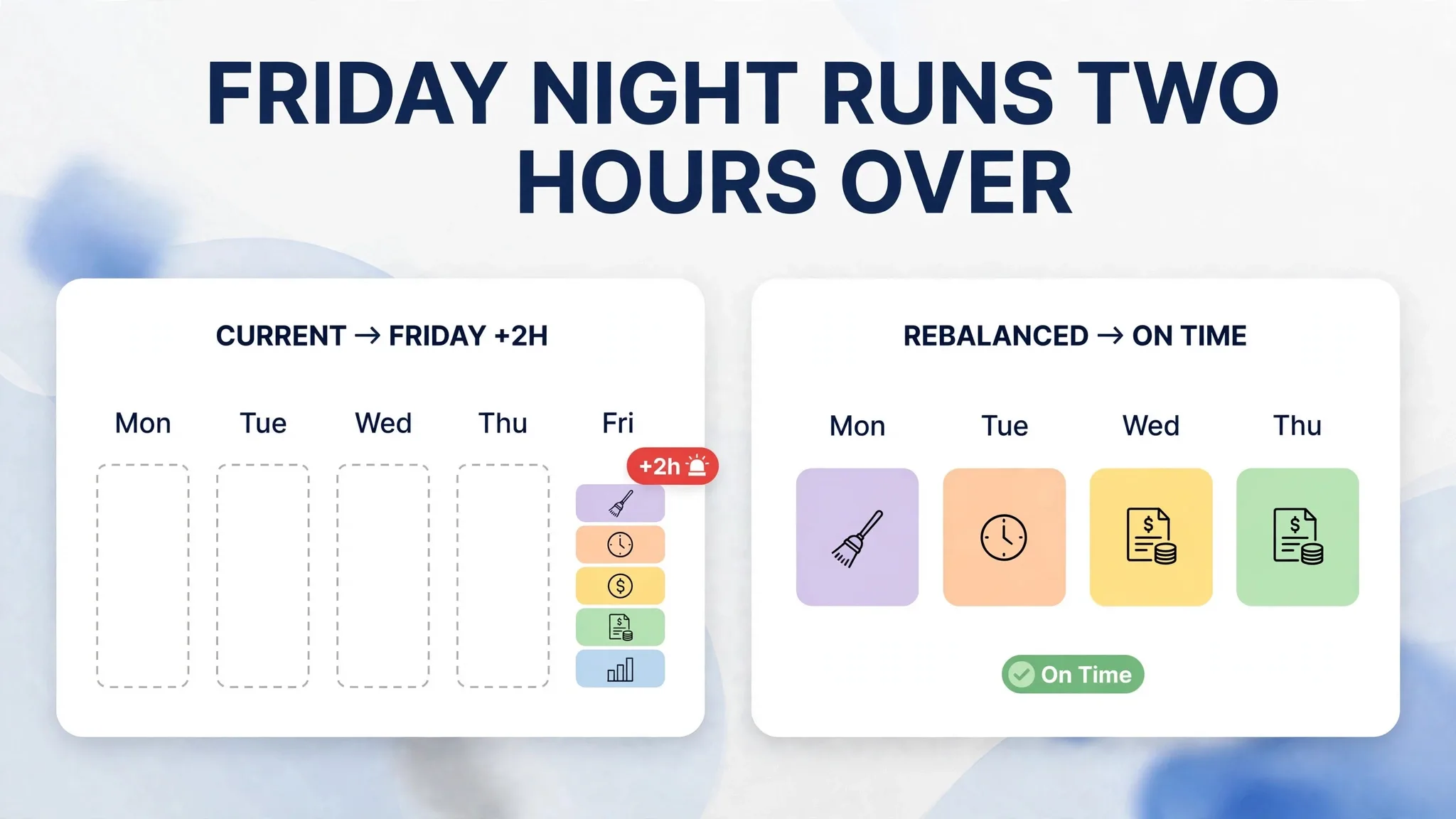
Weekly tasks are the ones that build up slowly: full vacuuming of low-traffic rooms, dusting desks and ledges, wiping partitions, and machine-scrubbing hard floors. Spread them across the week so no single night runs long.
Spreading's the part new operators miss. If every weekly task lands on Friday, Friday's shift runs two hours over and the crew rushes the daily work. Put high dusting on Monday, partitions on Tuesday, and floor scrubbing on Thursday, and each night stays close to the same length.
What gets cleaned monthly and quarterly?
Monthly and quarterly tasks are deep work: vents and light fixtures, baseboards, interior windows, carpet extraction, and stripping and refinishing hard floors. They'll usually need different equipment, and often a different crew.
Treat these as their own jobs on their own dates, priced so the client can see them. Strip and wax is the classic example. It'll take a full night per area, a floor crew, and planning around the nightly team. The post on automating quarterly strip and wax schedules covers how to keep it from slipping.
What does a complete task-frequency matrix look like?
A complete matrix lists each area of the building down the side and frequencies across the top, with an extra column for when to clean more often. It's the commercial cleaning schedule template most operators end up building for themselves.
The frequencies below are typical for a standard office in my experience on the operations side. They're a starting point, not a standard. Adjust them to the building you've walked.
| Area | Daily | 2–3x a week | Weekly | Monthly | Quarterly | Adjust up when… |
|---|---|---|---|---|---|---|
| Entrances and lobbies | Trash, spot-clean glass, vacuum mats, mop | – | Dust ledges and signage | Baseboards | Machine-scrub hard floor | Heavy foot traffic, winter weather |
| Restrooms | Disinfect fixtures, restock, mop | – | Descale, dust partition tops | Scrub grout, wash walls | – | High headcount, public access, medical |
| Break rooms | Counters, sinks, tables, trash, mop | Appliance exteriors | Microwave interior | Fridge cleanout, with client sign-off | – | Food prep, large teams |
| Open office | Trash and recycling, vacuum traffic lanes | Full vacuum, dust clear desk surfaces | Dust partitions and phones | Vents, baseboards | – | Full-occupancy days |
| Private offices | Trash | Vacuum | Dust clear surfaces | Detail dust | – | Executive suites, client-facing rooms |
| Hard floors | Dust-mop, damp-mop traffic areas | – | Auto-scrub | Burnish | Strip and wax | Winter grit, medical |
| Carpet | Vacuum traffic lanes | – | Edge vacuuming | Spot extraction | Hot-water extraction | Food areas, entrances |
| High dusting | – | – | – | Vents, light fixtures, cabinet tops | High ledges | Medical, allergy-sensitive tenants |
| Glass | Spot-clean entrance doors | – | Interior partitions | Reachable interior windows | Exterior windows, often subcontracted | Storefronts, glass-heavy lobbies |
Use the last column during the walkthrough. A medical office, a food-prep area, or a lobby with 500 people a day moves its rows up a frequency or two. That one column's what separates a schedule written for this building from a generic one. For an office-specific version that changes with headcount, see the office cleaning schedule guide.
How does cleaning frequency change the price?
Frequency drives price because it drives labor hours. Each task you're moving from weekly to daily adds its time to every night of the week, and labor's most of what a cleaning contract costs.
The math runs through production rates: how many square feet a cleaner can finish per hour for a given task. Multiply area by frequency, divide by the rate, and you've got hours. The guide to janitorial production rates covers where those numbers come from.
Here's a small illustration. Say moving private-office vacuuming from daily to three times a week saves one hour across the week. That's 52 hours a year. Median pay for janitors and building cleaners was $17.71 an hour in May 2025, according to the Bureau of Labor Statistics, so that hour's worth about $921 a year in wages alone, before employer taxes and overhead. Janitorial task frequency's one of the few levers you can show the client line by line.
How do you put the schedule into your proposal's scope of work?
Put the full frequency schedule in your proposal as its own section, right after the area-by-area scope. Clients compare bids line by line, and a clear frequency table makes yours the one that's easiest to compare.
Add two things the matrix doesn't show: what's excluded, and whether periodic work is in the monthly fee or billed per occurrence. The free commercial cleaning proposal template includes a 29-task frequency schedule you can edit to match your matrix.
How do you turn the schedule into checklists crews actually follow?
Turn the schedule into a checklist for each night by attaching daily tasks to every shift and weekly or monthly tasks to the specific nights they're due. Each cleaner should see only tonight's list.
A 60-line schedule on paper doesn't get followed. Tonight's 12 tasks on a phone do. In ProTeams, tasks attach to each shift and appear on the cleaner's phone as a digital checklist, and periodic task lists can run on any cycle from daily to annual. An incomplete task flags the shift, and each task is marked as completed on site or off site.
Then you'll check the work against the same list. A janitorial inspection checklist built from your frequency schedule means you're inspecting what the client is paying for, nothing more and nothing less. ProTeams offers inspection checklists too, so the inspection can live in the same system as the crew's checklist.
Frequently Asked Questions
How often should commercial spaces be cleaned?
Most commercial offices get restrooms, trash, break rooms, and entrances cleaned daily, with full vacuuming and dusting two to three times a week, deep work like vents and baseboards monthly, and floor refinishing or carpet extraction quarterly. High-traffic, medical, and food-prep areas need higher frequencies.
What is included in a commercial cleaning schedule?
A commercial cleaning schedule lists every cleaning task, the area it applies to, and how often it's done, from daily to quarterly. A good one also notes which tasks are excluded and when frequencies should increase, such as for heavy traffic or medical use.
How do I make a janitorial cleaning schedule?
Walk the building and list each area. For each area, write the tasks it needs and assign a frequency: daily, two to three times a week, weekly, monthly, or quarterly. Spread weekly tasks across different nights, schedule periodic work as separate jobs, and adjust frequencies up for high-traffic or sensitive areas.
What's the difference between a cleaning schedule and a crew schedule?
A cleaning schedule lists what gets cleaned and how often. A crew schedule says who's working which shift at which building. You need both, and the tasks on the cleaning schedule are what fill each crew shift.
Write the schedule before you write the price
Every number in a cleaning bid traces back to the frequency schedule: the hours, the crew, the price, and what the client expects to see each morning. Build the matrix from your walkthrough and put it in the proposal. Then make sure the crew's seeing the same list. To see how ProTeams turns your schedule into nightly checklists, book a demo or start your free trial.