
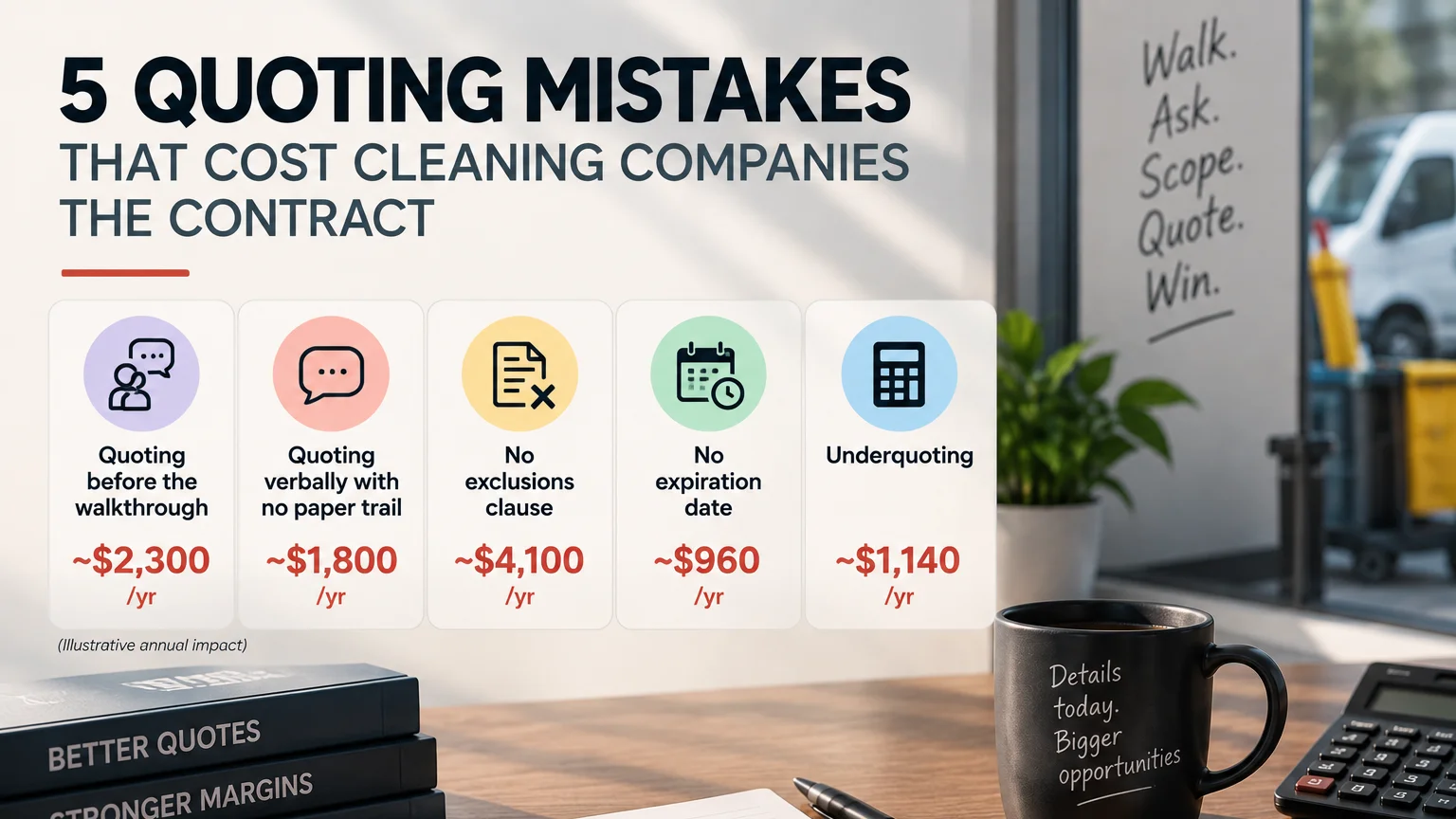
Most cleaning operators who lose bids blame price, but the real culprits are usually process mistakes: quoting before the walkthrough, leaving no paper trail, skipping exclusions, forgetting an expiration date, and underquoting to win. Knowing how to quote cleaning jobs well is less about the number and more about avoiding the five errors below — each of which costs you either the contract or the margin. The good news: every one is fixable, because every one is a process gap you control, not a market you don't.
I've built two commercial cleaning companies — ProCleanings in New York and Verdant in Texas — and I've made or watched every mistake on this list, usually while signing the contract that lost us money. The pattern that stings most is the operator who quotes five jobs, wins one, and assumes the four losses were about price. Usually they weren't. They were about a quote that came in slow, or vague, or without the structure that makes a client trust you. Here are the five that cost the most, each with what it actually does to your business. The scenarios are illustrative composites, but the mechanics are exactly what plays out.
Cleaning companies rarely lose bids purely on price — they lose on cleaning quote mistakes they don't realize they're making. That's really why cleaning companies lose bids they should win. Fix these five and your win rate moves without touching your rates.
Mistake 1: Quoting before the walkthrough
Quoting a building you haven't walked means pricing a building you're imagining — and imagined buildings are always easier to clean than real ones.
Here's how it happens: a prospect calls, asks for a ballpark, and you give one over the phone off the square footage they told you. It's efficient-feeling. Then you win it, show up, and the "10,000 square feet" includes six restrooms, a dense cubicle maze, and a freight elevator that eats fifteen minutes a night. The hours you priced? They don't exist. You're now losing margin on a contract you technically won.
Why it happens: speed feels like service, and walkthroughs take time. But knowing how to quote cleaning work accurately starts with seeing the work. What to do instead: never quote a commercial account without walking it, and walk it with a checklist so you capture the hour drivers — restroom count, floor mix, furniture density, access constraints — the same way every time. The walkthrough is the single highest-return fifteen minutes in your whole quoting process.
Mistake 2: Quoting verbally with no paper trail
A verbal quote is a quote the client gets to remember however benefits them — and they'll remember a lower number than you said.
You quote $1,600 a month on the phone. Three weeks later the client says, "I thought you said fourteen." Now you're either eating $200 a month or starting the relationship with an argument. Without anything in writing, it's your word against theirs, and you lose that one every time because you're the one who wants the contract.
Why it happens: a phone number feels faster than a document. What to do instead: follow every verbal conversation with a written quote, even a simple one, before the client has a chance to re-remember the number. The written quote is the record, and the record is what protects you when memories conveniently drift.
Mistake 3: Quoting without an exclusions clause
A quote that lists only what's included invites the client to assume everything else is included too — and scope creep does the rest.
This one has a number, so let me show it. Picture how this plays out: you quote a 12,000-square-foot office at what should be a healthy margin. Your quote lists what you'll do but never says what you won't. Two months in, the client starts adding — the break room "since you're here," then two conference rooms for a weekly wipe-down. None of it was priced. None of it was excluded, so the client genuinely believes it was always part of the deal.
Illustrative math: say those additions total about 45 minutes of extra labor per visit, five visits a week. At a burdened labor cost of roughly $21 an hour, that's about $16 a visit → ~$79 a week → roughly $4,100 a year in unpaid labor, on a contract you thought was profitable. Even at a conservative 30 minutes a visit, you're near $2,400 a year given away for free. (Illustrative figures — your labor cost and frequency will differ.)
Why it happens: naming exclusions feels negative, like you're being difficult before you've started. What to do instead: always include an explicit "not included" section — carpet extraction, floor stripping, extra rooms, event cleanup — listed as available add-ons at a stated rate. It's not negativity; it's the clause that turns "since you're here" into a quick, friendly "happy to, here's the add-on price."
Before you send a quote, run the numbers so you know your margin holds. The free cleaning bid calculator checks wage, burden, overhead, and margin in one place — or start your free trial or book a demo.
Mistake 4: Quoting without an expiration date
An open-ended quote is a price the prospect can sit on until your costs have moved out from under it.
You quote a building in March. The prospect goes quiet, shops your number around, and resurfaces in September wanting to sign — at the March price. But since March your wages went up, your supply costs rose, and the margin you built in has quietly evaporated. You either honor a stale price or start the relationship by explaining a price increase before day one. Both are bad, and both were avoidable.
Why it happens: nobody thinks to put a shelf life on a number. What to do instead: every quote carries an expiration — 30 days is standard. It'll protect your margin against moving costs, and it adds a gentle, legitimate reason for the prospect to decide rather than drift. "This quote is valid for 30 days" is a normal business line, not a pressure tactic.
Mistake 5: Underquoting to win the work
Winning a contract at a price below your real cost isn't winning — it's paying the client every month for the privilege of doing their cleaning.
This is the most tempting mistake, because it feels like hustle. You want the account, so you shave the number to beat the competition. You win. Then payroll hits, and the account loses money every single month for the length of the term. Here's the break-even the math actually forces:
Illustrative math — 15,000 sq ft office, 5 nights/week: say the work genuinely takes 3.5 labor hours a visit. At $21/hour burdened, that's $73.50/visit × ~21.7 visits a month ≈ $1,595/month in labor alone, before supplies, overhead, or a dollar of profit. Add ~$250 for supplies and overhead and your true cost floor is around $1,845. Quote it at $1,750 to win, and you're losing roughly $95 every month — about $1,140 over a year — to do the work. Win three like it and you've bought yourself a part-time job that pays negative wages. (Illustrative — your hours, wage, and overhead will differ.)
Why it happens: a signed contract feels like progress even when the number's wrong. What to do instead: know your true cost floor before you quote, and if you can't win at a profitable number, change the scope or frequency rather than the margin. Build the price from your own measured hours — the argument for that is in cleaning contract pricing per square foot — and use the janitorial production rates reference to sanity-check your hours before the number goes out.
Frequently Asked Questions
What are common quoting mistakes in cleaning?
The five most expensive quoting mistakes in commercial cleaning are: quoting before you've walked the building, quoting verbally with no written record, quoting without an exclusions clause, quoting with no expiration date, and underquoting to win the work. The first three lose you money on contracts you win; the last two lose you the contract outright or lock you into a losing price. All five are process failures, not pricing failures, which means all five are fixable with a checklist and a written quote.
How do cleaning companies lose contracts?
Cleaning companies usually assume they lose contracts on price, but more often they lose on the quote itself: a slow response, a vague scope, a bare number with no structure, or no follow-up after sending it. A client comparing two similar prices picks the company whose quote looked more professional and answered more questions. Price is the easy explanation, but the quoting process is the more common culprit, and unlike price, the process is something you fully control.
Why do you keep losing quotes you should win?
If you're quoting five jobs and winning one, the reflex is to blame your prices and start cutting them — which, if underquoting is one of your problems, makes things worse. Most quoting errors cleaning business owners make hide behind that price assumption. Look at the process first. Are you walking every building? Putting every quote in writing? Naming exclusions? Dating the quote? Pricing above your real cost floor? Each of those is a lever you control completely, and each one moves your win rate or your margin without touching the rate itself. The whole quoting process, start to finish, is laid out in the guide on how to quote cleaning services — start there, fix the gaps one at a time, and stop losing work you should be winning.
Quote it right, then prove you delivered it
A clean, complete quote wins the account. Keeping it takes proof the work happened, night after night, exactly as you quoted. That's the part most operators can't show — and the part that turns a won account into a renewed one.
ProTeams.io helps commercial cleaning companies centralize the systems that keep field operations moving:
- Crew scheduling and shift check-ins
- Field communication between office staff, supervisors, and cleaners
- Issue tracking and service requests
- Attendance visibility and field accountability
- Checklists and task completion follow-up
- Operational reporting across clients and locations
Deliver what you quoted, make it visible to the client, and the account stays yours.