
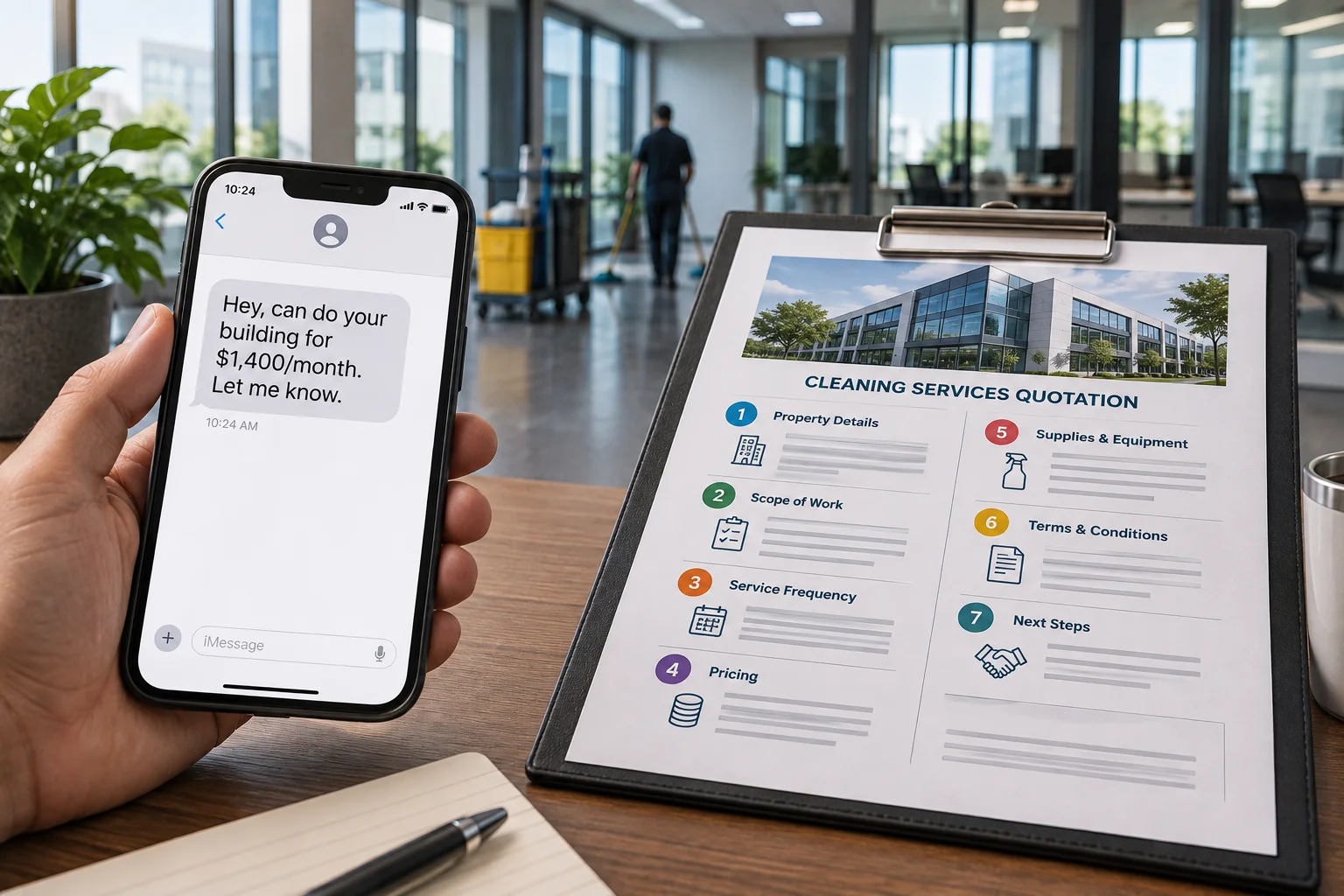
A cleaning quote template needs seven sections to win the work: a header, a scope summary by area, a frequency table, an included-versus-excluded list, the pricing with payment terms, an expiration date, and an assumptions section. Miss the last three and you've written a price, not a quote — and a bare price loses to a structured document every time, even when the price is lower. This is the section-by-section breakdown of what each part does and what it costs you to skip it. Not the downloadable file — the reasoning behind it.
I manage day-to-day operations at ProCleanings, and I also run quality assurance for ProTeams, which means I spend a lot of my time on the mess a bad quote leaves behind. The disputes three months in. The "I thought that was included" arguments. The scope nobody wrote down that now everyone's remembering differently. Almost every one of those fights traces back to a quote that was a number and nothing else. A clean, structured quote isn't just a better sales document — it's the thing that prevents the problems I spend my week untangling. The quote is the first work product a client ever sees from you, and they read it as a preview of how you'll run their account.
A winning cleaning quote isn't about a lower price — it's about a document structured well enough that the client trusts you before they've read the number. Seven sections do that work.
Why does the quote document matter more than the price?
The quote is the first sample of your work a client ever sees, so a structured, professional document signals reliability before price even enters the decision.
Picture the two quotes a client is comparing — a cleaning quote example of each, side by side. Here's the version too many operators still send:
The bad quote: a text message that reads, "Hey, can do your building for $1,400/month. Let me know." That's it. No scope, no frequency, no terms.
And here's what the operator who wins sends instead:
The professional quote: a one-page PDF with a header, an area-by-area scope, a frequency table, a clear included-and-excluded list, the monthly price with payment terms, a 30-day expiration, and a short assumptions section. Same building. Possibly a higher number. Wins anyway.
The difference isn't polish for its own sake. Each section answers a question the client would otherwise have to ask — or worse, assume. The structured quote closes the gaps where disputes and second-guessing live. The text-message quote leaves every one of them open. So what to include in a cleaning quote isn't a style question — it's about which gaps you're willing to leave open. Below is what each of the seven sections does, and what happens when it's missing.
What are the seven sections of a cleaning quote?
A commercial cleaning quote template has seven sections — the header, scope summary, frequency table, included-versus-excluded list, pricing and terms, expiration date, and assumptions — each closing a specific gap the client would otherwise fill with a guess.
1. Header. Your company name, logo, the client's building and address, the date, and a quote number. It seems trivial. It isn't — it identifies the document, makes it referenceable ("about quote #1043"), and signals from the first line that this is a real business record, not a casual note. The quote number also lets you track which quotes are outstanding.
2. Scope summary. What gets cleaned, broken out by area — lobby, restrooms, offices, break room — with the tasks under each. Not "we'll clean your building," but the actual work, space by space. This is where the client sees whether you understood their building, and it's the section that makes everything downstream specific instead of vague.
3. Frequency table. How often each task runs — daily, weekly, monthly, quarterly. A simple table is clearest:
| Task | Frequency |
|---|---|
| Restroom cleaning & restock | 5 nights/week |
| Vacuum carpeted areas | 5 nights/week |
| Mop hard floors | 5 nights/week |
| Dust surfaces | Weekly |
| High dusting / vents | Monthly |
| Carpet extraction | Quarterly (add-on) |
Frequency drives labor hours more than square footage does on many sites, so leaving it vague is how a profitable quote turns into an unprofitable contract. The table also makes upsells visible — the client sees the quarterly add-on and can say yes.
4. Included versus excluded services. The section that prevents scope creep, and the one most operators skip. List what's covered, then explicitly list what isn't: carpet shampooing, floor stripping, post-event cleanup, exterior windows, supply restocking beyond a set amount. Naming exclusions feels awkward the first time. It's the difference between "I thought that was included" becoming an argument versus a quick reference to the quote both of you agreed on.
Want the structure already built out? The free commercial cleaning proposal template gives you the scope, frequency, and terms sections ready to fill in — or start your free trial or book a demo to see how the work gets tracked once you win.
5. Pricing and payment terms. The monthly total, and — if it helps the client understand the value — a per-visit breakdown. Then the terms: the billing schedule, the payment window (net-15, net-30), and any late-payment terms. A price with no terms leaves the client guessing about how and when they pay, which is friction you don't want at the moment they're deciding. If you're still working out the number itself, that's a different job — we've covered cleaning contract pricing per square foot and why the market rate is a check, not a starting point.
6. Quote expiration date. How long the price holds — 30 days is the standard, and there's a reason it's not open-ended. Your costs move: wages, supplies, fuel. An open-ended quote binds you to today's costs indefinitely, and it removes any gentle urgency for the client to decide. "This quote is valid for 30 days" protects your margin and nudges the decision, both without any pressure that reads as pushy.
7. Assumptions and conditions. The conditions the price depends on, stated plainly: access hours, who supplies consumables, the square footage you based the quote on, and the change-order process for anything outside the scope. This is the section that saves you when reality differs from what you were told. If the building turns out 30% larger, or access is restricted to hours you didn't plan for, the assumptions section is what turns "the price is changing" from an argument into a clause you both already agreed to.
How do you present the quote once it's built?
The best cleaning service quote format is a clean one- or two-page PDF: deliver it that way, walk the client through it rather than emailing it cold, and give it an expiration that gently moves the decision.
The document does most of the work, but delivery finishes it. A PDF reads as more permanent and professional than a number typed into an email body. Where you can, walk the client through it — even a two-minute call to point at the scope and the assumptions turns the quote from a price they compare into a conversation they remember. For competitive or larger accounts, the quote grows into a full proposal, and the deeper version of that document is covered in how to write a commercial cleaning proposal. The whole process, from walkthrough to close, is laid out in the guide on how to quote cleaning services if you want the stages around the document itself.
Frequently Asked Questions
What should a cleaning quote include?
A cleaning quote should include seven parts: a header with your company name, date, and quote number; a scope summary broken out by area; a frequency table showing how often each task runs; an included-versus-excluded services section; the pricing with payment terms; a quote expiration date; and the assumptions and conditions the price depends on. The included-versus-excluded section and the assumptions are the two most operators skip, and they're the two that prevent disputes. A quote missing them is just a price with no protection around it.
How do you format a commercial cleaning quote?
Format a commercial cleaning quote as a clean one- or two-page document, not a text message with a number. Lead with a header that identifies you and dates the quote, then a scope summary by area, a frequency table, an included-and-excluded list, the price with payment terms, an expiration date, and an assumptions section. Structure signals professionalism before the client reads a word of detail, and a client comparing a structured quote against a competitor's bare number reads the difference as the difference between the two companies.
The document is the difference
When you lose a job you thought you'd priced well, it's easy to assume you were too expensive. Often you just sent a worse document. The operator who wins isn't always the cheapest — they're the one whose quote answered every question the client had before it was asked, named the exclusions before they became arguments, and looked like it came from a company you'd trust with your building. None of that requires a lower price. It requires seven sections, every time, on a clean page. Build the document once and reuse it, and you stop losing winnable work to operators whose only advantage was a better-looking quote.
Win the quote, then prove you delivered it
A structured quote wins the account. Keeping it takes proof the work happened — night after night, exactly as the quote laid out. That's the part most operators can't show, and the part that turns a won account into a renewed one.
ProTeams.io helps commercial cleaning companies centralize the systems that keep field operations moving:
- Crew scheduling and shift check-ins
- Field communication between office staff, supervisors, and cleaners
- Issue tracking and service requests
- Attendance visibility and field accountability
- Checklists and task completion follow-up
- Operational reporting across clients and locations
Deliver what the quote promised, make it visible to the client, and the account stays yours.