
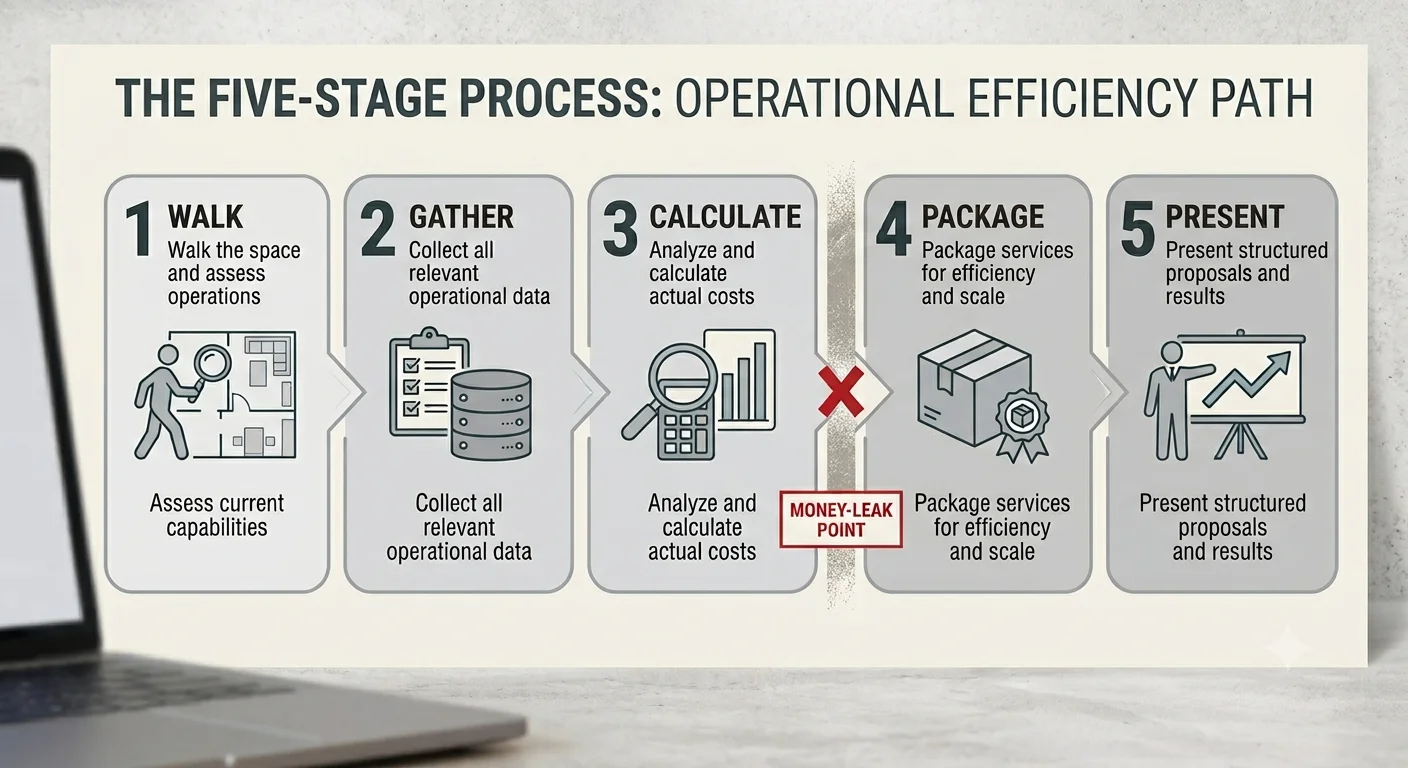
Quoting a cleaning service is a repeatable process, not a formula: you walk the building, gather what drives the hours, calculate the number, package it into a written quote, and present it so the client says yes. Most operators already know their rates. What they're missing is the system around the number — the walkthrough, the written scope, the terms, the delivery — and that gap is where the money leaks. A quote given over the phone without seeing the building is a guess, and guesses run under on labor. This guide is the process, start to finish.
I run operations at Verdant Building Service in Texas, so I'm the one who has to staff the accounts we quote — which means I feel every quote that came in low. We had a stretch where we won three new accounts in a quarter and were barely breaking even on two of them. Not because our rates were wrong. Because we'd quoted them fast, over the phone, without walking the buildings, and the labor came in heavier than the number assumed. The rates were fine. The process was missing. Fixing the process, not the math, is what turned those accounts around, and it's what this guide is about.
Quoting cleaning services is a process problem, not a pricing problem — most operators know their numbers but have no repeatable system for gathering, packaging, and presenting them. Build the system and the money stops leaking.
What is a cleaning quote versus a bid versus a proposal?
A quote is the price and what it covers; a bid is your response to a formal solicitation; a proposal is the full sales document that wraps the quote in the case for choosing you.
These three words get used interchangeably, and the confusion costs operators clarity with clients. Here's each one, cleanly.
A quote is the number and its terms. It states the scope, the frequency, the price, what's included and excluded, and how long the price holds. It's what a client asks for when they already know they need cleaning and want to know what you'll charge. For a small recurring account, a clean quote is often all you need.
A bid is a quote submitted into a competitive or formal process — a government RFP, a property manager collecting three prices, an institutional procurement. The number-building is the same; what's different is that you're one of several, and the format is often dictated by the buyer. A bid is a quote that has to compete on someone else's terms.
A proposal is the fuller document that surrounds the quote with persuasion: who you are, how you work, references, compliance, and why you're the safe choice. It's what you send when the account is big enough, or competitive enough, that the price alone won't win it. The quote answers "what will it cost." The proposal answers "why you." If you want the deep version of that document, we've covered how to write a commercial cleaning proposal separately.
The practical rule: every job needs a quote. Bigger or competitive jobs also need a proposal. The bid is just the quote in a competitive coat. Knowing which one the situation calls for is the first decision, because sending a bare quote into a competitive proposal situation loses, and burying a simple recurring account in a twelve-page proposal wastes everyone's time. The tell is usually the buyer: a single decision-maker who already wants you needs a quote; a committee, a formal RFP, or three competitors on the same building needs a proposal. Read the buying situation first, then pick the document to match it.
What information do you need before you quote?
Before you can quote honestly, you need the building in front of you: its size by area, its floor types, its soil level, its access constraints, and the frequency the client actually wants.
This is the step the phone quote skips, and it's the step that decides whether your number is real. You can't price hours you haven't seen. A building's square footage tells you almost nothing on its own — a 10,000-foot open floor plan and a 10,000-foot maze of private offices, dense furniture, and heavy-traffic restrooms are completely different labor, at completely different cost.
What the walkthrough is really for is finding the hour drivers: restroom count and fixture load, floor-type mix, furniture density, freight-elevator waits, security or access delays, and any areas that only clean on certain nights. None of those show up in a square-footage number, and every one of them moves your labor. Walk the building with a checklist so you capture them the same way every time — a repeatable pre-quote walkthrough is the single biggest upgrade most operators can make to their quoting.
Get the frequency in writing at this stage, too. "Five nights a week" and "as needed" are different contracts, and the difference is thousands of dollars over a term. Note the client's real priorities as well — the account you win on price you can lose on the one detail they cared about and you didn't ask. The information you gather here is the foundation everything else sits on — quote from a guess about the building and every downstream step inherits the error.
How do you calculate the number?
There are three common ways to reach a price — per square foot, production-rate workloading, and flat monthly — but only workloading from measured hours protects your margin.
This guide is about the process, not the math, so I'll keep this short and point you to where we've gone deep. There are three methods operators use. Per square foot multiplies area by a market rate — fast, and dangerous, because a single rate can't be right across building types and sizes. Production-rate workloading builds the price from how long the work actually takes on this building, then applies your burdened labor cost, overhead, and margin — this is the one that survives payroll. Flat monthly is how you present the final number to most commercial clients, but it should still be built from workloaded hours underneath.
The short version: build from hours, then check against the market — never the reverse. If you've ever wondered how much to charge for cleaning services and reached for a per-foot rate off a website, that's exactly the shortcut that runs you under on labor. We've written the full argument for why per-square-foot pricing is the wrong place to start, and the existing how to quote a commercial cleaning job walkthrough runs the seven-step calculation end to end with a worked example. The mechanics of how to quote a cleaning job — the per-visit math, the burden multiplier, the margin — live there in full. This guide assumes you can reach a defensible number and focuses on what you do with it.
Once your hours are workloaded, the free cleaning bid calculator keeps wage, burden, overhead, and margin consistent from quote to quote. When you're ready to see how the work gets tracked after you win, start your free trial or schedule a demo.
What should a cleaning quote include?
A complete quote answers three unspoken client questions — what am I getting, what am I paying, and what happens if the scope changes — through seven concrete line items.
Every client reading your cleaning service quote is silently asking three things. What exactly am I getting? What exactly am I paying, and when? And what happens if something changes? A quote that answers all three cleanly wins trust; one that leaves a gap invites either a dispute or a competitor. Here's the framework that covers all three:
- Scope of work by area. What gets cleaned, broken out by space — not "the building," but the lobby, the restrooms, the offices, the break room.
- Frequency. How often each area is serviced. This drives hours more than square footage on many sites, so it can't be vague.
- Inclusions and exclusions. What's covered and — just as important — what isn't. Naming exclusions is how you stop scope creep before it starts.
- Price and what it covers. The number, and clearly what it does and doesn't buy.
- Payment terms. The billing schedule and the payment window, net-15 or net-30, with any late terms.
- Expiration date. How long the price holds. Costs move; an open-ended quote is a liability.
- Assumptions. The conditions the price depends on — square footage, access, soil level. If they turn out different, the price adjusts. This is the line that protects you.
That assumptions line is the one operators skip most and need most. It's the difference between "the price went up and now we're arguing" and "the building was 30% larger than you told me, and here's the clause we both agreed to." A structured quote template makes this repeatable so you're not rebuilding the format every time — see the full breakdown of what each section of a cleaning quote does if you want the document itself.
What are the most common quoting mistakes?
The costly quoting mistakes are all process failures: quoting without a walkthrough, leaving frequency or exclusions vague, forgetting the expiration date, and pricing to win instead of pricing to profit.
The number-one mistake is the one that cost my team two accounts: quoting over the phone without seeing the building. It feels efficient and it's expensive, because you're pricing a building you're imagining, not the one you'll clean. Close behind it is vague frequency and missing exclusions — the gaps that turn into "but I thought that was included" three months in.
The subtler mistakes are about discipline. No expiration date, so a quote from spring binds you at fall costs. Pricing to beat a competitor instead of to cover your hours, which wins the job and loses the margin. And presenting a bare number with no scope or terms, which reads as unprofessional and gives the client nothing to trust. Each of these is a process gap, not a math error — which is good news, because a process gap is fixable with a checklist and a template.
How do you present the quote to win the work?
Presentation wins or loses close quotes: deliver a written, itemized quote quickly, walk the client through it rather than emailing a bare number, and follow up on a set cadence.
Speed matters more than operators think. A clear quote delivered within a day or two of the walkthrough, while you're fresh in the client's mind, beats a slightly better price that arrives a week late. Clients read a fast, complete quote as a signal of how you'll run the account — responsive and organized. A slow one signals the opposite before you've cleaned a single night. But speed without structure backfires — fast and sloppy reads worse than slow and thorough. The move is to have the process tight enough that fast and thorough is your normal.
How you deliver it matters too. A quote emailed as a bare number invites a price comparison and nothing else. A quote walked through — even briefly, on a call — lets you explain the scope, point at the assumptions, and answer the three unspoken questions before they harden into objections. For competitive or larger accounts, that's where the quote graduates into a proposal, and the commercial cleaning proposal template gives you the structure to present it professionally. Then follow up — once, with value, a few days later. Not to nag, but to answer questions and stay in front of the decision.
Do you need cleaning quote software?
You need quoting software when spreadsheets stop keeping up — when volume, consistency, or team handoffs make a manual process error-prone.
For a solo operator doing a few quotes a month, a good template and a calculator are plenty. The question changes as you grow. When you're quoting weekly, when more than one person builds quotes and they need to look consistent, when you're losing track of which quotes are outstanding and which need follow-up — that's when a spreadsheet starts costing you more than it saves. The signal isn't a number of quotes; it's the moment the manual process starts producing mistakes or dropped follow-ups. A missed follow-up on a quote you worked hard to build is money left on the table just as surely as an underpriced number is. The tooling question is really a consistency question: can your process produce the same complete, professional quote every time, no matter who builds it or how busy the week is.
To be straight about where ProTeams fits here: we don't generate quotes or proposals for you today. What ProTeams does is everything after the quote is won — proof of service, scheduling, and the field systems that make sure the work you quoted actually gets delivered and documented. The quote wins the account; proving the work keeps it. If your bottleneck is building and sending quotes, a template and calculator are your tools today. If it's delivering and defending the work after you win, that's where we come in.
Frequently Asked Questions
How do you quote a cleaning service?
Quoting a cleaning service is a five-part process: walk the building, gather the information that drives labor hours, calculate the number from your own costs, package it into a written quote with scope and terms, and present it in a way that answers the client's real questions. Most operators are fine at the math and weak at the process around it, which is where money leaks. A quote given over the phone without a walkthrough is a guess, and guesses run under on labor. Build the same repeatable steps every time and your quotes stop costing you margin.
What should be included in a cleaning quote?
A complete cleaning quote includes seven things: the scope of work by area, the service frequency, clear inclusions and exclusions, the price and what it covers, payment terms, an expiration date, and the assumptions the price depends on. The assumptions line is the one most operators skip and the one that protects them, because it names the conditions (square footage, access, soil level) that would change the price if they turn out different. A quote without frequency or exclusions is incomplete and invites a dispute later.
What is the difference between a cleaning quote and a cleaning proposal?
A quote is the price and what it covers: scope, frequency, terms, and a number. A proposal is the fuller sales document that wraps the quote in persuasion — your company, your approach, references, and why you're the right choice. A bid sits between them, usually referring to your response to a formal solicitation. In practice a small recurring account often needs only a clean quote, while a competitive or institutional account needs a full proposal. The quote is the number; the proposal is the case for choosing you.
Fix the process, not the price
If you're barely breaking even on accounts you thought you priced right, the problem usually isn't your rates — it's everything around them. The phone quote that skipped the walkthrough. The vague frequency. The missing assumptions line. The bare number emailed without a conversation. Every one of those is a process gap, and process gaps are fixable in a way that "I'm just charging too little" isn't. Build the walkthrough into every quote, package the number into a real written quote with all seven line items, present it like you mean it, and follow up. Do that consistently and you stop leaving money on the table — not because you raised your rates, but because you finally stopped giving margin away for free.
Win the quote, then prove you delivered what you priced
A good quote wins the account. Keeping it takes proof the work happened, night after night, exactly as the quote promised. That's the part most operators can't show — and the part that turns a won account into a renewed one.
ProTeams.io helps commercial cleaning companies centralize the systems that keep field operations moving:
- Crew scheduling and shift check-ins
- Field communication between office staff, supervisors, and cleaners
- Issue tracking and service requests
- Attendance visibility and field accountability
- Checklists and task completion follow-up
- Operational reporting across clients and locations
Deliver what you quoted, make it visible to the client, and the account stays yours.