
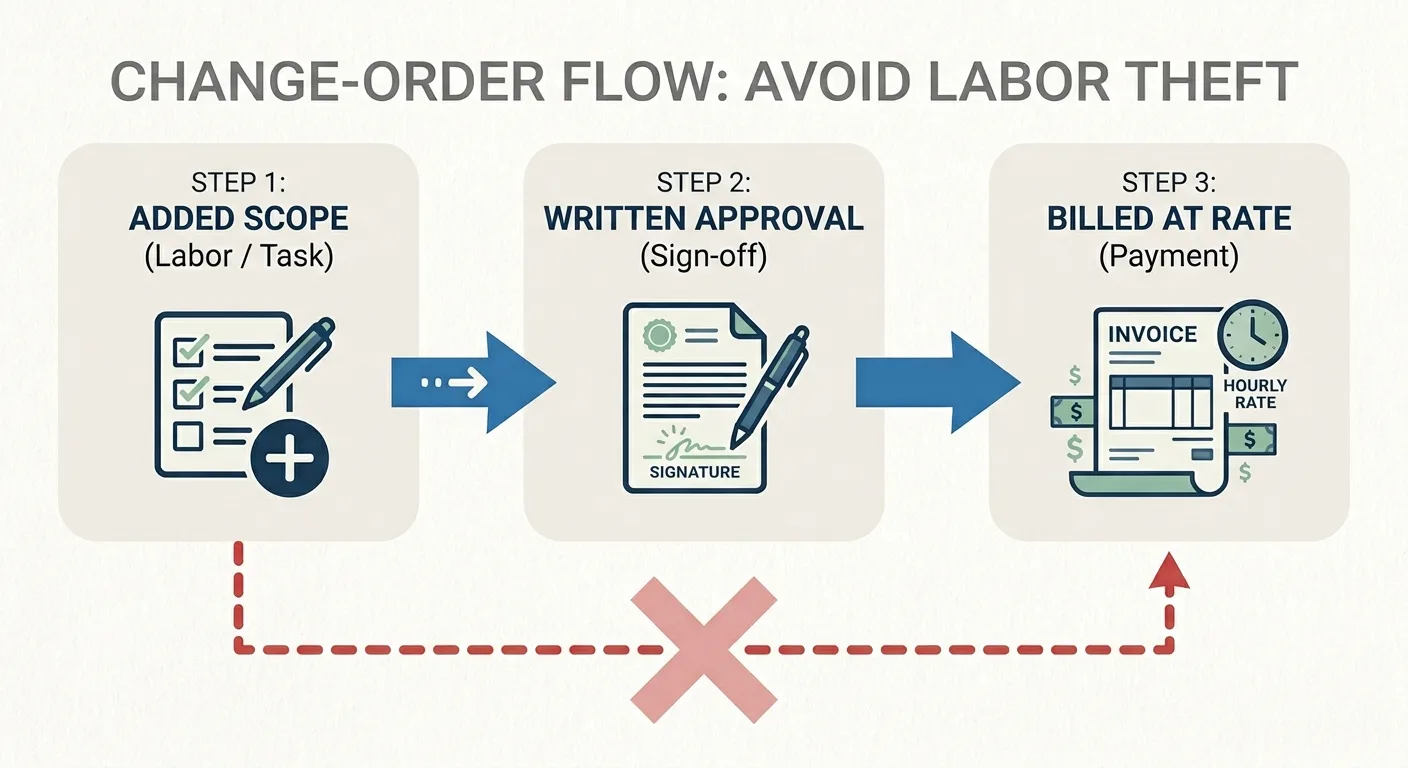
To write a cleaning contract that protects both sides, you need seven clauses working together: scope of work, term and renewal, pricing and payment, a change-order clause, cancellation and termination, insurance and liability, and a not-included section. The two that prevent the most disputes are the scope of work and the change-order clause — together they define what you're obligated to do and what happens the moment someone asks for more. A handshake and a scope email feel faster. They cost more the first time the scope quietly grows.
I run operations at Verdant Building Service in Texas, and I've lived the version that goes wrong. We took a 20,000-square-foot office on what amounted to a one-page scope email — felt fine, the client seemed reasonable. Four months in, two restrooms and a break room had been added to the "agreed" scope, with nothing written to point to. No change-order clause, no signed document, no line I could hold up and say "that's outside what we agreed." We ate the labor. That's the month I stopped treating the contract as paperwork and started treating it as the thing that protects the crew I staff.
A cleaning contract, sometimes called a cleaning service agreement, isn't the pitch — it's the binding agreement that decides what happens when the scope grows, the client pays late, or either side wants out. Build your cleaning contract template before you need it — you can't add a clause after the dispute starts.
A quick, honest caveat: this is operational guidance from someone who signs these contracts, not legal advice. Contract law varies by state, and the language that makes a clause enforceable is a lawyer's job. Use this to understand what your contract should cover, then have an attorney review the document before you sign.
What is a cleaning contract versus a proposal?
A proposal is the sales document you send to win the work; a cleaning contract is the legally binding agreement you both sign after you've won it.
People use the words interchangeably, and it costs them. The proposal's persuasion — it presents your company and price to convince a prospect to pick you. The contract's obligation — what you're both bound to once they have. A proposal says "we'll keep your building spotless." A contract says which areas, how often, at what price, and what's different if that changes. One's a pitch; the other's enforceable.
A strong proposal often becomes the skeleton of the contract, but signing is the moment it stops being what you'd like to do and becomes what you're required to do. For the sales-document side, the commercial cleaning proposal template covers how to structure a winning pitch. This post is the document you sign after it works.
What are the essential cleaning contract clauses?
Seven clauses do the real work of any commercial cleaning contract terms sheet: scope of work, term and renewal, pricing and payment, change orders, cancellation and termination, insurance and liability, and a not-included section.
Scope of work. The heart of the contract, structured by area with task and frequency, ideally as a table. "Third-floor restrooms: restock, disinfect, mop, 5 nights a week. Lobby: vacuum nightly, glass weekly." The more specific, the less room for the "I thought that was included" talk later.
Term and renewal. How long it runs and what happens at the end. A fixed term ends on a date; an auto-renew rolls into another term unless someone cancels by a deadline. Auto-renew protects your revenue, but spell it out — a client trapped by a renewal they forgot about leaves angry.
Pricing and payment terms. The monthly rate, the invoice schedule, and the payment window — net-15, net-30 — plus a late-payment clause with a stated fee. "Net-30" with no consequence for net-60 is just a suggestion. Note what triggers a price review here too.
Change-order clause. The one that would have saved me on that office account, and the clause competitors' templates cover worst. It states that any work beyond the written scope — added areas, frequency, or tasks — requires written approval and is billed at your rate before work begins. It turns "can you also do the break room" from a favor you absorb into a documented, priced conversation. Without it, a term contract dies by a hundred small yeses.
Cancellation and termination. How either side exits, and with how much notice — 30, 60, or 90 days is standard. Spell out termination for convenience (either side, with notice) and for cause (a material breach, with a cure period). It'll protect you from a client walking mid-term and protect them from a service that isn't working.
Insurance and liability. Your coverage minimums — general liability, workers' comp — and a commitment to provide a certificate of insurance. Some buildings require specific limits or to be named as an additional insured. It's what stands between you and catastrophe if something goes wrong on-site.
Not-included section. The tasks the contract explicitly excludes: carpet extraction, floor stripping, post-event cleanup, exterior work. Naming what you're not doing is the other half of the scope-creep defense — list them as add-ons at a separate rate.
A contract defines the obligation. Proof of service is how you show you met it. See how proof of service documents the work, or start your free trial or book a demo.
What are the most common cleaning contract mistakes?
The costly mistakes are all versions of leaving something unwritten: verbal scope additions, no termination clause, missing insurance minimums, and frequency language vague enough to argue about.
Verbal scope additions are the number-one killer, and they're what happened to me. A client asks for one more room, you say sure, and now it's part of the "agreement" with no price attached. Every addition runs through the change-order clause, in writing, or it isn't real.
No termination clause leaves you exposed to a client who disappears mid-term. Missing insurance minimums can turn one on-site accident into an existential event. And ambiguous frequency language — "as needed," "periodically" — is a dispute waiting to happen, because your "as needed" and the client's are never the same. Write numbers: nightly, weekly, a specific count. If a clause reads two ways, a client under budget pressure reads it the way that costs you.
The thread through all of these is the office-account lesson: the work happens after hours, in a building the client isn't watching, and memory is a bad substitute for a signed document. Once the contract's right, the next problem is proving you're meeting it. Time-stamped proof of service and completed checklists give you a record the obligations were met, so a dispute is settled by evidence instead of argument.
Contract, proposal, or SLA — when do you need each?
You need a proposal to win the work, a contract to govern it, and sometimes a service-level agreement to define the standard it's held to.
The proposal sells; the contract — call it a janitorial service contract or a cleaning service agreement — binds you at signing. An SLA is a separate layer some institutional clients require, defining measurable standards and the consequences if you miss them. For most small and mid-sized accounts, a well-written contract with a specific scope's enough. The contract is one stage of a bigger path — see how to get commercial cleaning contracts for the full sequence, and cleaning contract pricing per square foot for why the price should come from your own numbers, not a market rate.
Frequently Asked Questions
What should be in a commercial cleaning contract?
A commercial cleaning contract needs seven core clauses: a detailed scope of work broken out by area with task and frequency, the contract term and how it renews, pricing and payment terms including late fees, a change-order clause that ties any added scope to a price adjustment, cancellation and termination notice, insurance and liability minimums, and a not-included section listing what's explicitly excluded. The scope of work and the change-order clause are the two that prevent the most disputes, because between them they define exactly what you're obligated to do and what happens when someone asks for more.
How do I prevent scope creep in a cleaning contract?
Put a change-order clause in the contract and a not-included section in the scope. The change-order clause states that any work beyond the written scope requires written approval and gets billed at your stated rate before it starts. The not-included section names the tasks you're not doing, so there's no assumption to argue about later. Without both, added restrooms, extra square footage, and 'while you're here' requests get absorbed for free, which is how a profitable contract quietly turns unprofitable over a term.
What is the difference between a cleaning proposal and a cleaning contract?
A proposal is a sales document you send to win the work: it presents your company, your price, and your terms to persuade a prospect to choose you. A contract is the legally binding agreement you both sign after they've chosen you: it defines the obligations, the term, the payment schedule, and what happens if either side wants out. The proposal wins the deal; the contract governs it. A strong proposal often becomes the backbone of the contract, but signing turns it from a pitch into an enforceable agreement.
Write it before you need it
Nobody's signing a cleaning contract expecting trouble. You sign one so when trouble comes — the added room, the late invoice, the exit — a document already answered the question. The contract isn't distrust. It's what lets a good relationship survive the moment something changes, because both sides already agreed what happens next. Get the scope specific, get the change-order clause in, and have a lawyer check it before you sign.
Win the contract, then prove you earned it every night
The bid gets you the account. Keeping it takes evidence the work happened, in a building the client never sees, night after night. That's the part most operators can't show, and it's the part that turns a won contract into a renewed one.
ProTeams.io helps commercial cleaning companies centralize the systems that keep field operations moving:
- Crew scheduling and shift check-ins
- Field communication between office staff, supervisors, and cleaners
- Issue tracking and service requests
- Attendance visibility and field accountability
- Checklists and task completion follow-up
- Operational reporting across clients and locations
Make the work visible, and the contract you fought to win becomes the one nobody can take from you.