
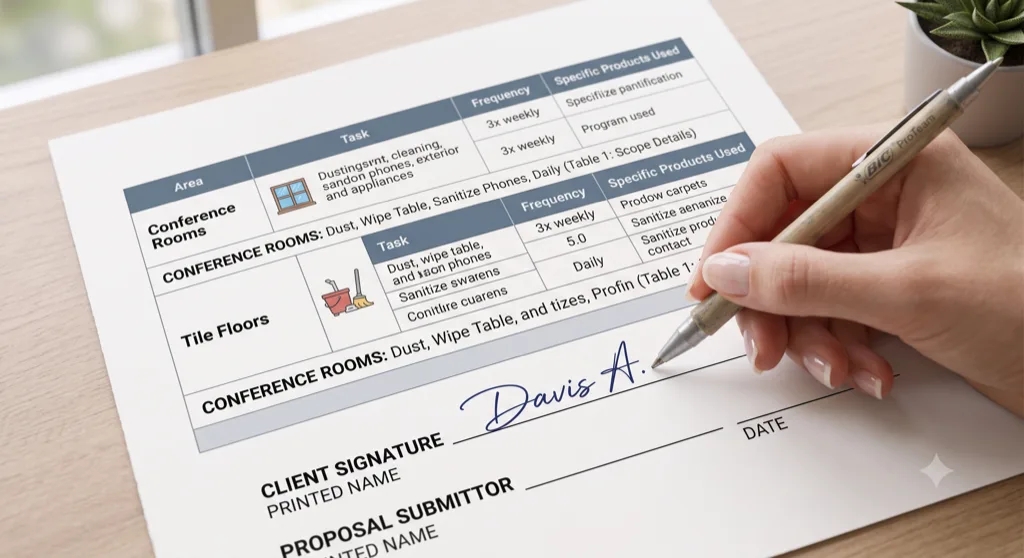
Learning how to write a cleaning proposal comes down to one truth: a commercial cleaning proposal wins or loses on the scope of work, not the price. The document itself has a settled shape the industry agrees on: a cover page, a short company intro, a detailed scope of work broken out by area, a service schedule, tiered pricing, proof of insurance and references, terms, and a signature line. Get the scope specific enough and you look like the operator who walked the building and understood it. Leave it vague and you look like everyone else who emailed a number. That gap is where contracts are actually won.
I lost bids for years to companies with worse pricing than mine. Took me too long to see why. My proposals were a paragraph about us, a lump-sum price, and a call-me-with-questions line. Theirs were four pages that read like they'd already started the job. The client wasn't buying a lower number. They were buying the one who clearly knew what they were walking into. I run ProCleanings in New York and Verdant in Texas, and I rebuilt how both companies bid around that single realization.
A proposal is a promise, and the operators who win renewals are the ones who can prove they kept it. Write the scope like you mean it, and back it with evidence the client can actually see.
What should a commercial cleaning proposal include?
Eight sections, in this order: cover page, company intro, scope of work, schedule, pricing, proof and compliance, terms, and a signature line.
That structure isn't my invention. It's the shape nearly every proposal guide converges on, because it maps to the order a client reads in: who're you, what exactly will you do, when, for how much, can I trust you, what am I agreeing to, where do I sign. Skip a section and you've left a question open, and an open question's a reason to pick the other bid.
The cover page and company intro are quick. Name, logo, the client's building and address, the date, and two or three sentences on who you are and what you specialize in. Don't spend three pages on your history. Nobody's signing a cleaning contract because your company was founded in 2009. They sign because the scope tells them you understood their floor.
Why is the scope of work the section that wins?
Because the scope of work is where the client sees whether you actually walked their building, and specificity reads as competence while vagueness reads as a cut corner.
Structure the cleaning proposal scope of work by area, not by task. Clients think about their building in spaces, not cleaning categories. There's the lobby, the restrooms, the third-floor cubicles, the break room, the stairwells. Under each area, list the specific tasks and the frequency, ideally as a two-column table. "Restrooms: restock and disinfect, 5 nights a week. Floors mopped nightly, deep-scrubbed monthly." That's a sentence the client can check against their own experience of the building. A generic "we clean restrooms" isn't.
This is also where you separate a proposal from a scope of work, which people conflate. The janitorial bid proposal template for formal solicitations goes deeper on the standalone SOW you'd attach to a larger RFP, but even a short bid needs the area-by-area detail in the body.
One more thing the scope has to do: name what you're not doing. A not-included section feels awkward the first time you write it, but it's the single best defense against the slow bleed of scope creep. Carpet shampooing, floor stripping, post-event cleanup, exterior work, supply restocking beyond a set amount. List them as available add-ons, and you've turned "can you also just…" from an expectation into a quote.
How should you present pricing in a cleaning proposal?
Present pricing in three tiers on a single page, with the option you actually want to win sitting in the middle.
Good, better, best. There's a basic package that covers the core scope, a recommended one that adds the things most buildings genuinely need, and a premium one with day-porter coverage or added floor care. Three tiers do two jobs: they let the client self-select by budget instead of walking away at one number, and they anchor the middle option as the sensible choice. Most clients pick the middle. That's the point.
What the tiers should not do is turn into a pricing lecture. The proposal presents the number; it doesn't show your cost math. How you arrive at a defensible price is its own discipline, and I've written separately about how to price the job so the tier you put in front of a client is one you can actually deliver at a margin. Get the number right before it goes in the proposal. The proposal's job is to present it well, not to derive it.
If you'd rather not build the pricing tables and cover copy from scratch, the free commercial cleaning proposal template gives you the scope tables, the tiered pricing page, and the terms already laid out. Fill in your building, cut what doesn't apply.
What makes a client trust the proposal enough to sign?
Proof. Insurance certificates, references, and a credible answer to the question every facility manager is really asking: how do I know your crew will actually show up and do the work?
The compliance part's table stakes. General liability and workers' comp certificates, two or three references, any certifications that fit the building type. Medical and daycare facilities will want background-check and chemical-handling detail spelled out. Include it without being asked and you clear a bar the sloppy bidders trip over.
But the deeper trust question is about the promise itself. A proposal is a promise about work that happens after hours, in an empty building, where the client never sees it. The operators who keep commercial accounts for years are the ones who can prove the promise was kept. That's where the pitch stops being about the document and starts being about how you run. Time-stamped proof of service means every visit leaves a verifiable record: who was on-site, when, and photo evidence of the work. A client portal means your customer can see it themselves instead of taking your word. Most of your competitors are still promising. Being able to say "and here's how you'll know we did it" is the line that wins the renewal.
You don't have to overstate the tooling to make this point. You've just got to be the operator whose proposal answers the trust question when everyone else's stops at the price.
Frequently Asked Questions
What should be included in a commercial cleaning proposal?
A commercial cleaning proposal needs eight parts: a cover page, a short company intro, a detailed scope of work broken out by area with task and frequency, a service schedule, pricing (usually in good/better/best tiers), proof of insurance and references, a terms section with a not-included list and change-order clause, and a signature line. The scope of work is the section that decides whether you win, because it's where the client sees whether you actually understood their building.
How long should a cleaning proposal be?
For a commercial account, four to six pages is the working range. Shorter than that and you probably haven't detailed the scope enough to be credible; much longer and you're padding. The length should come from the scope of work being specific, not from marketing copy about your company. A small single-site contract can run shorter; a multi-building or medical facility bid runs longer because the scope and compliance sections carry more.
How do I prevent scope creep in a cleaning contract?
Two things, both in the proposal. First, a not-included section that names the work you're not doing, so there's no assumption to argue about later. Second, a change-order clause stating that any out-of-scope request needs written approval and gets billed at your stated rate. Together they turn a favor the client expects for free into a documented conversation. Vague scopes are where margin quietly disappears over a contract term.
What's the difference between a cleaning proposal and a scope of work?
The proposal is the sales document: it presents your company, the price, and the terms, and asks for the signature. The scope of work is the operating document inside it: the area-by-area list of exactly what gets cleaned, how often, and to what standard. The proposal wins the contract; the scope of work runs it once you've won. A strong proposal is mostly a strong scope of work with a cover and a price attached.
The proposal is the first promise
Before a client ever sees your crew, they see your proposal, and they're reading it for one thing underneath all the sections: can I trust this company to do what it says. Every specific line in the scope, every named add-on, every reference and certificate is you answering yes. The price matters, but the price is the easy part to match. If you're figuring out how to win commercial cleaning contracts, this is the lever: a proposal that reads like you've already understood the building, plus a way to prove you kept the promise once you win it.
Want to see the shape filled in? The cleaning proposal examples show a completed bid with weak and strong versions of each section, side by side. Steal the strong ones.
Win the bid, then prove you earned the renewal
A great proposal gets you the contract. Keeping it takes evidence the work happened, night after night, in a building the client never sees. That's the part most operators can't show and the part that keeps accounts for years.
ProTeams.io helps commercial cleaning companies centralize the systems that keep field operations moving:
- Crew scheduling and shift check-ins
- Field communication between office staff, supervisors, and cleaners
- Issue tracking and service requests
- Attendance visibility and field accountability
- Checklists and task completion follow-up
- Operational reporting across clients and locations
Deliver what the proposal promised, and make it visible to the client who signed it.