
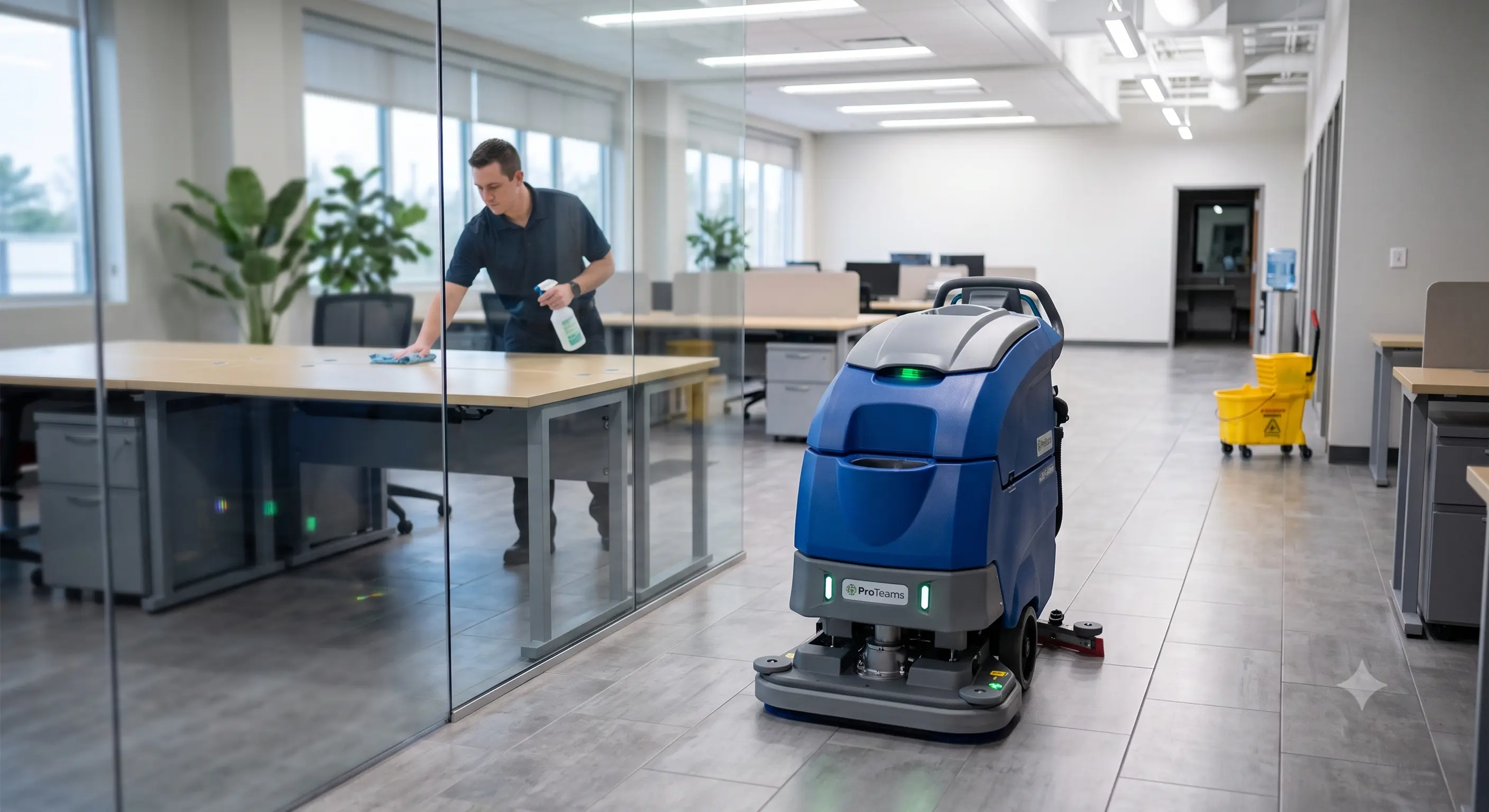
Cleaning businesses and workers face a genuine market paradox: the services sector keeps growing while job growth stalls. Automation threatens to displace workers, yet the technology remains prohibitively expensive to deploy at scale. The tension between market expansion and employment stagnation reveals what's really at stake — persistent pressure on wages, job security, and the viability of automation as a solution.
Understanding this gap matters for businesses planning investments and workers assessing long-term prospects in an industry that's transforming faster than technology can keep up. The short answer: robots are coming, but they're not replacing your crew anytime soon.
How market demand and job growth have diverged
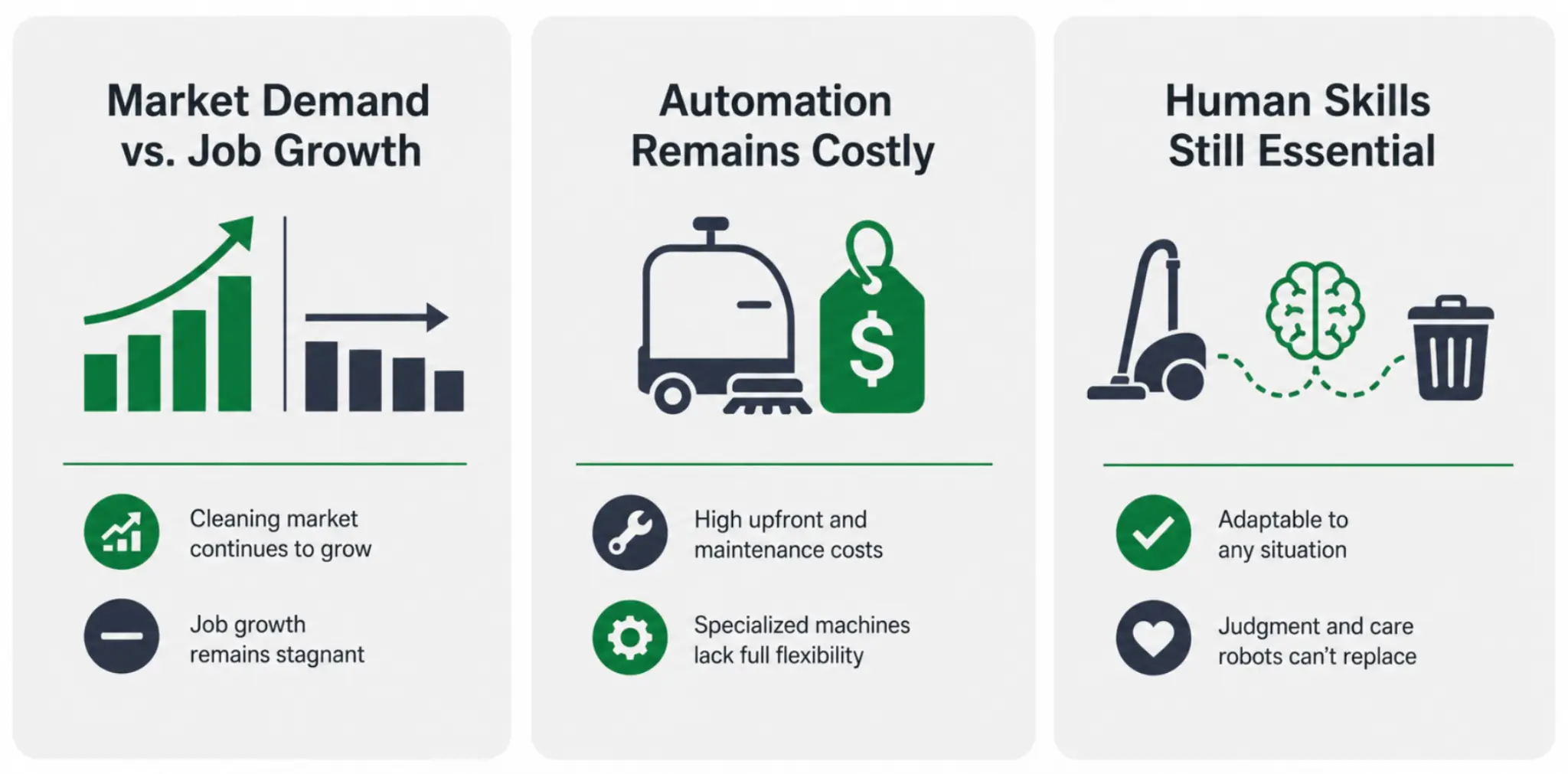
Two forces shape the cleaning market today. The first comes from the BLS Occupational Outlook Handbook for janitorial jobs. Government data shows the number of roles in this field is expected to grow by just 2% between now and 2034 — slower than the average across every occupation tracked by the BLS.
There are currently around 2.45 million cleaning jobs nationally, and the BLS estimates 351,300 openings arise each year. That figure seems to contradict the slow-growth stat — until you look at why those openings exist. The majority aren't new jobs being created; they're positions vacated by workers changing careers or retiring. The BLS handbook explicitly singles out new cleaning technology as a limiting factor for employment growth over the next decade.
Government data makes it clear: automation will be a key cause of stagnation in cleaning and janitorial roles through 2034, even as roughly 2.5 million people will still be working in the field when that year arrives.
The cleaning services market keeps expanding — but jobs lag behind
The second half of the story comes from the market's impressive growth trajectory. A Grand View Research report projects a 6% CAGR through 2033, putting annual revenues above $147 billion — with upward momentum continuing beyond that window.
More revenue, flat headcount. That gap is being filled by operational efficiency — not just hardware. Streamlining the administration side of cleaning businesses through field service software gives operators the means to meet growing client demand without waiting to acquire cutting-edge cleaning robots. Commercial cleaning software that handles scheduling, dispatch, and proof of service lets a lean team cover more ground — which is exactly the kind of leverage that matters when labor costs are rising and robot economics don't yet pencil out.
Why automation remains uneconomical at scale
The part of the story that gets overlooked is what cleaning robots actually cost, and how that compares to what they can do.
The BLS pegs median pay for a cleaner at $35,930 per year — roughly in line with entry-level commercial-grade robots. High-end models run upward of $80,000, according to Sedona Technology. In isolation, that math suggests a robot pays for itself in year one through saved wages. But Sedona Technology also points out that annual maintenance costs can reach 20% of the purchase price — and that's before accounting for the eventual need to replace the unit entirely once it reaches end of serviceable life. Software-dependent machines face obsolescence when manufacturers end support.
There's also the specialization problem. Most widely deployed cleaning robots handle one primary task: floor cleaning. They can't move from vacuuming to polishing furniture to changing bed linen to emptying bins the way a human worker does across a single shift. That adaptability — responding to unexpected spills, assessing surface types, adjusting to client preferences — requires judgment, not programming. It's precisely why human workers remain essential.
I run two commercial cleaning companies, and we've evaluated robotic floor scrubbers twice in the past three years. Both times, the maintenance overhead and task limitations pushed the ROI timeline out far enough that investing in better inspection and verification software made more sense. We got more measurable value out of tightening the operational side than we would have from a machine that only handles floors.
Frequently Asked Questions
Will robots replace cleaning workers?
Not in the near term, and likely not completely even long-term. BLS data projects cleaning job growth will be slow through 2034 partly due to automation, but 2.45 million people still work in the field — and robots can't yet replicate the full range of tasks a human cleaner handles in a shift. The realistic scenario is displacement of specific tasks (floor cleaning, in particular) rather than wholesale replacement of workers.
How much do commercial cleaning robots cost?
Entry-level commercial-grade cleaning robots are priced comparably to a cleaner's annual median wage of around $35,930. High-end models run $80,000 or more. On top of the purchase price, annual maintenance can add up to 20% of the unit cost, and machines face obsolescence once manufacturer software support ends. The total cost of ownership is substantially higher than the sticker price suggests.
Why is cleaning job growth stagnant despite market expansion?
The cleaning services market is growing at roughly 6% annually and is projected to exceed $147 billion by 2033 — but most of that revenue growth is being captured through efficiency gains rather than headcount increases. Most job openings in the field replace workers who've left rather than representing new positions. The BLS explicitly identifies technology as a limiting factor for net job creation in this sector.
What tasks can cleaning robots actually do?
Most deployed commercial cleaning robots specialize in floor care — vacuuming, mopping, or scrubbing. They can't reliably transition between tasks the way a human worker does. Tasks requiring judgment (responding to spills, reading surface conditions, adjusting to client feedback) remain firmly in human territory. Until robots can handle multi-task shifts end-to-end, human workers remain essential for most commercial cleaning environments.
How can cleaning businesses compete without expensive robots?
By tightening the operational side: scheduling software, GPS check-in verification, automated client reporting, and digital inspection tools. These investments carry a fraction of the cost of robotics and deliver immediate ROI by reducing administrative overhead, cutting no-shows, and providing clients the proof of service they increasingly demand. Automation of business operations — not just physical cleaning — is where most operators will find the biggest near-term gains.
Conclusion
Automation in the cleaning industry is real, but it's not an existential threat to human workers — at least not yet. The economics of cleaning robots don't support widespread deployment, the technology remains task-limited, and the market's revenue growth is being absorbed through smarter operations rather than hardware. Businesses that invest in cleaning business management software now are building the operational foundation that makes them competitive regardless of how robot economics shift over the next decade.