
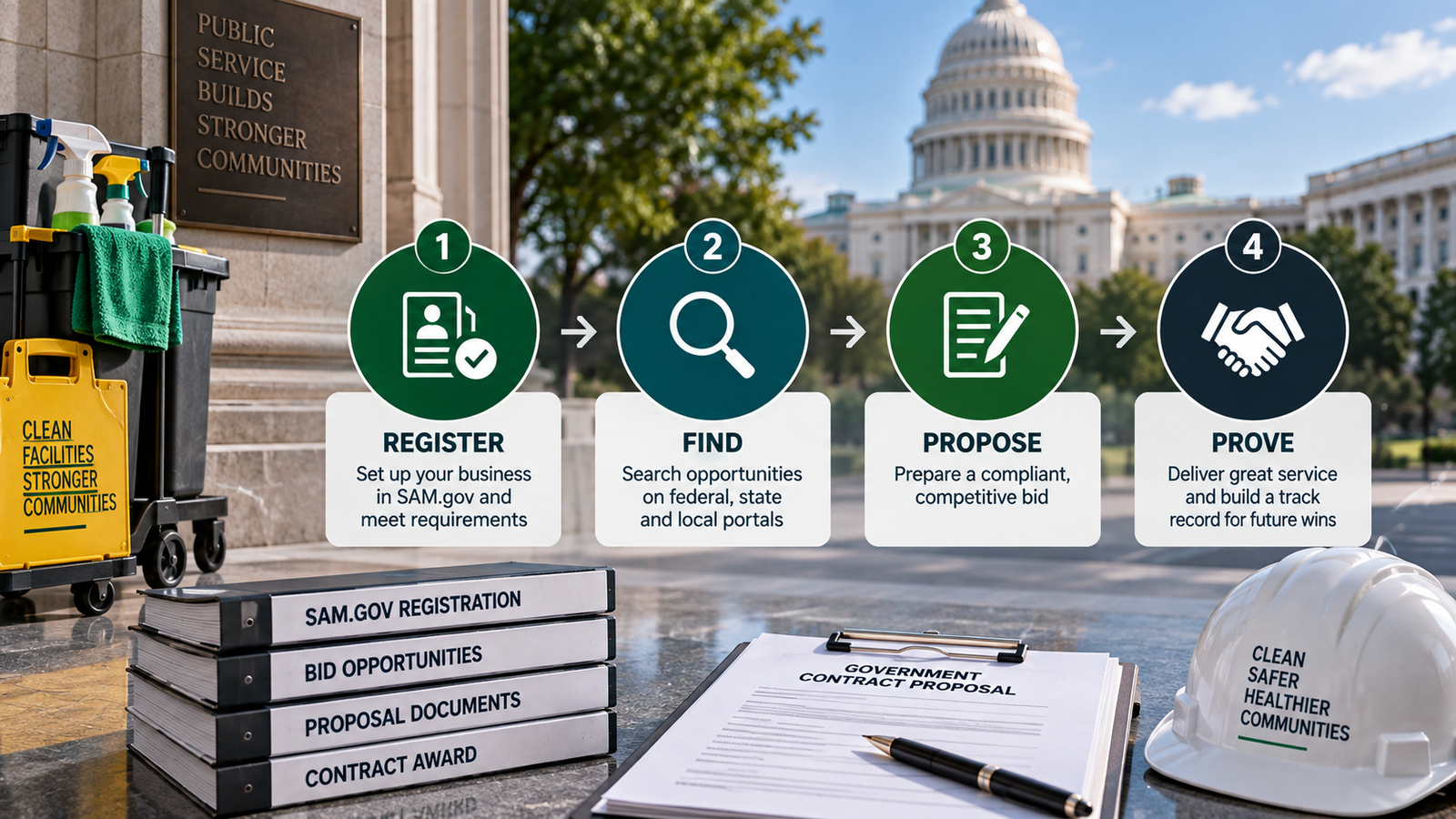
To bid on a government cleaning contract, you work four stages: register your business (SAM.gov for federal, separate portals for state and local), find opportunities that fit your size, write a proposal that answers every evaluation factor in the solicitation, and prove you can deliver. The paperwork intimidates most operators into never starting — which is exactly why the ones who push through face a thinner field than they expect. Government work is large, stable, and pays on time. This guide walks the whole path, from your first registration to how evaluators actually score what you submit.
I've built two commercial cleaning companies, and for years I treated government contracts as someone else's game — too much paperwork, too much mystery. That was a mistake. The registration is tedious but finite, and once it's done, you're looking at a market where a lot of your private-sector competitors never bother to compete. The barrier that scared me off was the same barrier keeping the field small. If you've been watching contracts scroll by on SAM.gov and assuming they're not for you, this is the guide I wish I'd had before I finally bid.
Government cleaning contracts run on a defined process — register, find, propose, prove — and the paperwork that scares operators off is exactly what keeps the competition thin. Learn the process once and a whole market opens up.
What types of government cleaning contracts exist?
Government cleaning contracts fall into three levels — federal, state and county, and municipal — and they differ sharply in size, competition, and how hard they are to win.
Federal is the largest and most formal tier: GSA buildings, military installations, federal courthouses, VA facilities. These run through federal procurement with the heaviest compliance requirements, and they're often large enough to transform a company. They're also the most competitive and the slowest to win, so they're rarely where a first-timer should start.
State and county contracts — courthouses, DMVs, state office buildings, county facilities — are the sweet spot for a lot of growing BSCs. They're substantial and stable, the compliance load is real but lighter than federal, and the competition is narrower because you're competing regionally rather than nationally. Each state runs its own procurement system.
Municipal is the most accessible entry point: city halls, public schools, libraries, transit facilities, parks buildings. Contracts are smaller, the paperwork is the lightest of the three, and local presence is an advantage. School districts in particular put out a steady stream of recurring janitorial work. If you've never bid a government contract, this is where to cut your teeth before moving up. Knowing which tier you're targeting matters, because it decides everything downstream — the registrations, the portals, and the size of the compliance mountain you're about to climb.
What registrations and certifications do you need?
For federal work you need an active SAM.gov registration and the right NAICS codes; small-business set-aside certifications can open dedicated opportunities but aren't required to bid.
Start with the baseline. SAM.gov — the System for Award Management — is the mandatory, free federal registration. You can't bid on or be awarded a federal contract without an active registration, which assigns you a Unique Entity Identifier and takes roughly 10 to 15 business days to clear. The full walkthrough, including the documents you need and the mistakes that get registrations rejected, is in the guide on where to find commercial cleaning contracts, which covers the SAM.gov process step by step. State and local work runs through separate portals, each with its own registration.
NAICS codes classify what your business does, and cleaning has two that matter: 561720 (janitorial services) and 561722 (carpet and upholstery cleaning). You'll select these during registration, and solicitations are tagged with the NAICS codes they want, so getting yours right is how the correct opportunities find you.
Small-business set-aside certifications are the lever most operators overlook. The federal government reserves a large share of contracts for small businesses, and socioeconomic programs create dedicated pools with far less competition. The main ones worth knowing: 8(a) (for socially and economically disadvantaged owners), HUBZone (businesses in historically underutilized business zones), SDVOSB (service-disabled veteran-owned), and WOSB/EDWOSB (women-owned). You don't need any of these to bid — but if you qualify for one, it opens set-aside contracts where you're competing against a much smaller field. Certification takes effort, and for the right company it's one of the highest-return moves in government contracting.
Where do you find government cleaning opportunities?
Federal opportunities live on SAM.gov; state and local ones live on separate government procurement portals; and expiring contracts on USASpending.gov show you what's about to come up for rebid.
SAM.gov is the federal opportunity feed as well as the registration system — you can search active solicitations by NAICS code, location, and set-aside type. State and local procurement portals are where the more accessible work is posted; every state runs one, and large counties, cities, and school districts often run their own. This fragmentation is annoying, but it's also why local contracts are less competitive: national players don't chase them.
The move most operators miss is USASpending.gov, which tracks federal spending including current contracts and their end dates. Find a janitorial contract expiring in your area in eight or ten months, and you've found a rebid you can prepare for well in advance — while the incumbent's competitors are still asleep. Piggybacking is another underused path: some government contracts allow other agencies to buy off an existing awarded contract, so getting onto one vehicle can open doors to others. Finding the opportunity is only the first stage of the larger picture; the full path from sourcing to closing any commercial contract is laid out in the pillar guide on how to get commercial cleaning contracts.
How do government evaluators actually score a bid?
Government cleaning bids are scored one of two ways — Lowest Price Technically Acceptable or Best Value Tradeoff — and the solicitation's evaluation section tells you which, so you read that before you write a word.
This is the part almost no guide explains for cleaning operators, and misunderstanding it is how good companies waste effort on losing proposals. There are two source-selection methods, and they call for completely different strategies.
Lowest Price Technically Acceptable (LPTA). The government sets minimum requirements, checks each proposal pass/fail against them, and awards to the lowest-priced bid that passes. Technical merit above the minimum earns you nothing — once you clear the bar, it's a price game. LPTA is common for straightforward, well-defined janitorial work. If the solicitation is LPTA, don't over-invest in a fancy technical approach; hit every requirement cleanly and price as sharp as you can while staying profitable.
Best Value Tradeoff (BVT). Here the government weighs non-price factors — technical approach, past performance, quality control — against price, and can legitimately pay more for a stronger proposal. This is where a smaller, higher-quality operator can beat a cheaper competitor. Under BVT, the technical and past-performance sections are worth real investment because they can outweigh a lower price.
The critical thing to understand: the weightings are set per solicitation, not by a universal formula. In a federal RFP, the evaluation criteria live in Section M, and they spell out the exact factors and how they're weighted relative to each other. As one representative example, a best-value janitorial solicitation might weight technical approach at 40%, past performance at 30%, and price at 30% — but the next one might weight price at 50%, or make past performance the most important factor. Never assume. The single most valuable habit in government bidding is reading the evaluation section first and building your entire proposal to answer exactly what it says it will score.
| LPTA | Best Value Tradeoff | |
|---|---|---|
| How it awards | Lowest price that meets the minimums | Best combination of quality and price |
| Technical factors | Pass/fail | Scored and weighted |
| Your strategy | Meet every requirement, price sharp | Invest in technical + past performance |
| Where to confirm | Solicitation evaluation section | Solicitation evaluation section |
Government contracts require documented proof of service — and that's exactly what ProTeams is built for. See proof of service, or start your free trial or book a demo.
What goes in a government cleaning proposal?
A government cleaning proposal has four core components: your technical approach, a quality control plan, past performance references, and a compliant price proposal — each answering a specific evaluation factor.
Unlike a private-sector proposal, a government proposal is graded against stated criteria, so its structure mirrors the evaluation factors. Miss one and you can be ruled non-responsive and tossed before your price is even read.
Technical approach. How you'll actually perform the work — staffing, scheduling, methods, equipment, how you'll handle the specific building. Under BVT this is often the highest-weighted factor, so it's where a strong operator earns the premium. Be specific; evaluators reward detail that proves you understand the site.
Quality control plan. How you'll ensure the work meets standard — inspections, corrective-action processes, how problems get caught and fixed. Government contracts take this seriously, and a vague quality plan reads as risk. This is also where your ability to document and prove service delivery becomes a selling point.
Past performance. Usually three references from comparable contracts, with contract numbers, dollar values, and contacts who can speak to your reliability. For BVT this is typically the second-heaviest factor. If you're new to government work, this is the hardest section to fill — which is the real reason to start with smaller municipal contracts and build a track record you can cite later.
Price proposal. Your pricing in the exact format the solicitation demands, built from your own costs. The commercial cleaning proposal template gives you a professional structure to adapt, and the free cleaning bid calculator helps you build a number from real labor hours rather than guesswork — critical here, because on a multi-year government contract an underpriced bid is a multi-year loss you can't easily escape.
What compliance documentation is required?
Government contracts require documentation most private jobs don't: insurance certificates, wage-law compliance, background checks, and often specific security clearances depending on the facility.
The compliance load is real and varies by contract, so read each solicitation's requirements carefully. Common ones include general liability and workers' compensation certificates at stated minimums, compliance with prevailing-wage laws (the Service Contract Act sets minimum wages and benefits on many federal service contracts), employee background checks, and — for secure facilities — personnel security clearances. Some contracts require a bid bond or performance bond.
None of this is optional, and missing a required document can disqualify an otherwise strong bid. Build a compliance checklist for each solicitation and confirm every item before you submit.
How do you prove service delivery on a government contract?
Government contracts frequently require documented, verifiable proof that the work was performed — timestamps, photo logs, and inspection records — making service documentation a contractual obligation, not a nice-to-have.
This is where government work differs most from private cleaning, and where a lot of operators get caught off guard. A government contract often specifies that you must be able to prove service was delivered — not just claim it. Contracting officers and facility managers can require timestamped records of when your crew was on-site, photo documentation of completed work, and inspection reports tied to a quality-control plan. Fail to produce them and you risk deductions, corrective-action notices, or a contract termination that also damages the past-performance record you need for the next bid.
This is exactly the problem commercial cleaning software like ProTeams is built to solve. Proof of service gives you timestamped, location-verified records of who was on-site and when, with photo evidence of completed work — the documentation a government contract demands. Paired with real-time visibility and the checklists that back a quality-control plan, it turns "prove you did the work" from a scramble into a report you can pull on demand.
Frequently Asked Questions
How do I get a government cleaning contract?
Getting a government cleaning contract takes four steps: register your business (SAM.gov for federal, plus your state and local procurement portals), find opportunities that match your size and location, write a proposal that responds to every evaluation factor in the solicitation, and prove you can perform. The paperwork is the barrier that scares most operators off, which is exactly why the ones who push through it face less competition. Start with smaller state, county, or municipal contracts before federal — the requirements are lighter and the field is smaller.
What is SAM.gov and do I need it?
SAM.gov is the U.S. government's official System for Award Management — the free registration and opportunity portal you must be registered in to bid on or receive federal contracts. Registration is free, assigns you a Unique Entity Identifier, and takes roughly 10 to 15 business days. If anyone charges you to register, they aren't the government. You need SAM.gov for federal work; state, county, and municipal contracts run through their own separate procurement portals, so you may need to register in several places depending on where you bid.
How are government cleaning bids evaluated?
Government cleaning bids are evaluated one of two ways, and the solicitation tells you which. Lowest Price Technically Acceptable (LPTA) awards to the cheapest bid that meets the stated minimum requirements — technical factors are pass/fail. Best Value Tradeoff weighs technical approach, past performance, and price together, and can award to a higher-priced bid if its quality justifies the premium. The evaluation section of the solicitation (often 'Section M' in federal RFPs) lays out the exact factors and their relative weight, so read it first and build your proposal to match.
The paperwork is the moat
Everything that makes government contracts intimidating — the registration, the compliance, the formal evaluation, the documentation — is the same thing that keeps the competition thin. Most cleaning companies take one look and go back to chasing private accounts. The ones who learn the process find a market that's large, stable, pays reliably, and renews. Start small with a municipal or school contract, get your SAM.gov registration and NAICS codes in order, read every solicitation's evaluation section before you write, and build the proof-of-service habit government work demands. Do it once and you've built something most of your competitors never will: a repeatable way into contracts they're too intimidated to bid.
Government contracts demand proof. Make it something you can pull on demand.
Government cleaning contracts don't just ask you to do the work — they require you to prove it, with timestamps, photos, and inspection records. That documentation protects the contract and the past-performance record that wins your next one.
ProTeams.io helps commercial cleaning companies centralize the systems that keep field operations moving:
- Crew scheduling and shift check-ins
- Field communication between office staff, supervisors, and cleaners
- Issue tracking and service requests
- Attendance visibility and field accountability
- Checklists and task completion follow-up
- Operational reporting across clients and locations
Prove every visit, protect every contract, and build the record that wins the next bid.