
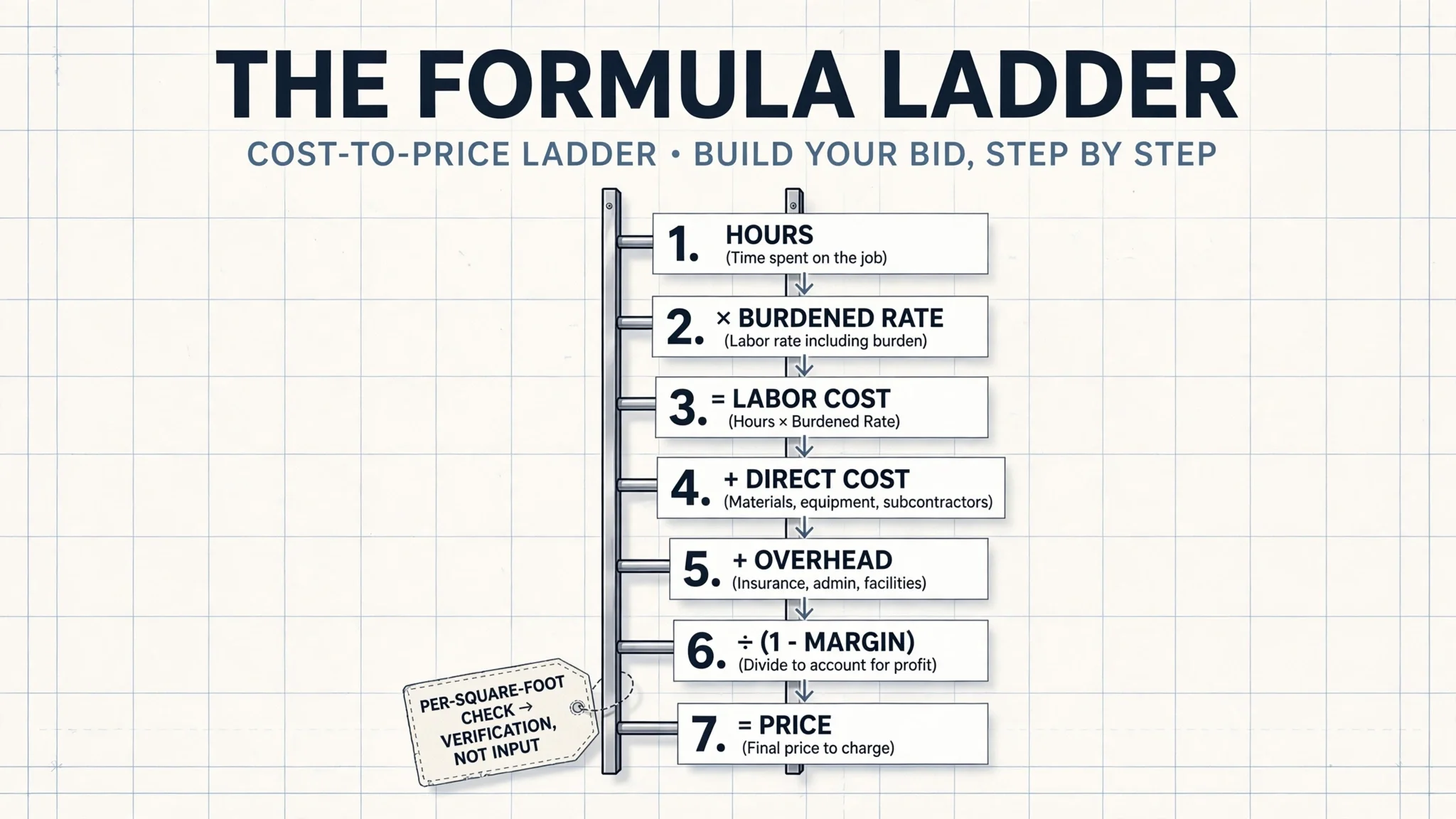
A commercial cleaning quote should come from three inputs: the labor hours the building takes, your true cost for each of those hours, and the margin you need to keep. Square footage, frequency, and building type all feed into those three; they don't replace them. Price from the inputs and you'll know exactly what each account earns. Price from memory or a competitor's rate card and you won't find out until the account's already losing money.
I've priced jobs both ways at ProCleanings and Verdant, and gut feel cost us more than any competitor ever did. The numbers felt right. Then a renewal would come up, someone would come in 12% lower, and I'd realize I couldn't say whether matching them meant thin profit or a loss, because I'd never built the price from parts. This guide walks through the method I use now, section by section, alongside the free commercial cleaning calculator that does the arithmetic for you.
Every commercial cleaning price comes down to hours, burdened labor cost, and margin. Get those three right and the price takes care of itself. Get the labor cost wrong and the margin you think you've got doesn't exist.
What three inputs determine a commercial cleaning price?
Every commercial cleaning price is built from three inputs: labor hours, the true (burdened) cost of each labor hour, and your markup for overhead and profit. Everything else you know about the building changes one of those three.
Square footage changes hours. So do frequency, building type, floor mix, and restroom count. Your location changes the wage. Your office, vehicles, insurance, and management time change overhead. Margin's your decision. Once you see every factor as a lever on one of three inputs, pricing stops being a guess and becomes a calculation you can check. This guide covers the numbers. If you want the full process of how to quote a commercial cleaning job, from the first call through the walkthrough to the proposal you send, that's in the step-by-step quoting guide. Your commercial cleaning quote is only as good as the number inside it, so we'll start there.
Here's the whole method in one table. It's the same sequence the calculator follows, and it's worth keeping next to you for every bid.
| Step | Calculation |
|---|---|
| 1. Labor hours per month | Hours per visit × visits per month |
| 2. Burdened labor rate | Hourly wage × burden multiplier |
| 3. Labor cost | Labor hours × burdened labor rate |
| 4. Direct cost | Labor cost + supplies and consumables |
| 5. Cost with overhead | Direct cost × (1 + overhead %) |
| 6. Price | Cost with overhead ÷ (1 − target margin %) |
| 7. Check | Price ÷ square footage, compared against your local market |
How do you calculate labor hours for a cleaning job?
Calculate labor hours either from production rates (square feet cleaned per hour for each type of space) or from a timed walkthrough estimate, then multiply hours per visit by visits per month. The best estimates use both.
The production rate method divides each area's square footage by how many square feet an experienced cleaner covers per hour in that kind of space. Open office goes fast. Restrooms, break rooms, and private offices go slow. Published rates are a starting point, and the janitorial production rates reference lays them out by space type. Your own crews' measured rates are always better than anyone's published ones, because published figures assume conditions your buildings may not have.
The walkthrough method is what you do on site: walk the building, count restrooms and fixtures, note floor types and furniture density, and estimate how long each zone takes your crew. It catches what square footage hides, like a freight elevator that eats fifteen minutes a night or a lobby that needs touch-ups twice a shift.
Picture the account that started this: a 15,000-square-foot office cleaned five nights a week. Production rates and the walkthrough both land around four labor hours per night. Multiply by roughly 21.7 visits a month and you've got about 86.8 labor hours a month. That's the number everything else is built on, which is why it deserves the most care.
Don't stop estimating once you've won. For the first month on a new account, compare the time your crew actually spends on site against the hours you priced. If a four-hour estimate is really running five, you've found a 25% labor overrun while it's still early enough to adjust scope, staffing, or price at the first review.
How do you calculate the true cost of cleaning labor?
True labor cost is the wage plus everything you pay because someone is on your payroll: payroll taxes, workers' compensation, unemployment insurance, and any benefits. Multiply the wage by that burden before you price anything. Pricing on raw wage is the most common silent margin killer in commercial cleaning.
Start with the wage. According to the U.S. Bureau of Labor Statistics Occupational Employment and Wage Statistics program, the national median wage for building cleaning workers was $17.56 an hour in May 2025. Your local rate may be higher or lower, and BLS publishes figures by metro area if you'd like a local benchmark.
Then add the burden. Employer FICA alone is 7.65% of wages (6.2% for Social Security and 1.45% for Medicare). On top of that you pay federal and state unemployment insurance, workers' compensation, and any paid time off or benefits. Together those commonly push true labor cost to around 1.2 to 1.35 times the wage. Use your own payroll records to find your number; 1.25 is a reasonable example.
The burden math: $17.56 an hour × 1.25 burden = $21.95 an hour true cost.
On our 15,000-square-foot office at 86.8 hours a month, that's about $1,905 a month in labor, not the $1,524 the raw wage suggests. That roughly $380 a month gap is invisible on the bid and very visible on the payroll.
Here's what that gap does to an account. Suppose you price the office with $120 a month in supplies, 15% overhead, and a 15% target margin, but you use the raw wage. Your price comes out around $2,225 a month. Your real cost with overhead, using the burdened wage, is about $2,329. You'd believe you were earning 15%. You'd actually be losing roughly $105 a month, about $1,250 a year, on an account that looks perfectly healthy. Pull last year's payroll, add up every employer cost tied to it, divide by gross wages, and you've got your real burden multiplier. Do it once a year, because workers' comp and unemployment rates change.
How much overhead and margin should you add?
Add overhead as a percentage of direct cost, then divide by one minus your target margin; many cleaning companies plan with overhead and margin each somewhere in the 10% to 25% range, but your own books should set both. Don't stack them as simple markups.
Overhead's everything that isn't on-site labor or supplies: office and admin staff, insurance, vehicles, software, equipment, and your own management time. Look at last year's books, divide those costs by your total direct costs, and that's your real overhead percentage.
Margin is where operators trip on the math. A 15% margin means 15% of the price is profit, so the price is cost divided by 0.85. Multiplying cost by 1.15 instead gives you a lower number and a smaller real margin. On our example, the correct method prices the office at about $2,740 a month; stacking 15% and 15% as markups gives about $2,678. It's a small gap on one account and a real one across thirty.
Run the burdened example all the way through and the office prices at roughly $2,740 a month, or about $0.18 per square foot per month. The competitor who came in 12% lower: about $2,411. Against a true cost with overhead of about $2,329, that's a margin near 3%. Either they run leaner than you, or they're pricing on raw wage and don't know it yet. Knowing your own numbers is what lets you tell the difference.
How do building type and frequency affect commercial cleaning pricing?
Building type and frequency change price by changing hours: denser, more detailed spaces take longer per square foot, and more frequent service multiplies those hours across more visits. That's why one per-square-foot rate across every building type underprices some accounts and overprices others.
| Building type | Effect on hours per square foot | Why |
|---|---|---|
| Open-plan office | Lower | Large open floors clean quickly; fewer fixtures per square foot. |
| Private-office layout | Higher | More doors, desks, and trash points in the same footage. |
| Medical or clinic | Much higher | Disinfection standards, more restrooms and sinks, detailed surfaces. |
| Warehouse or industrial | Lower for floor area | Big open floors, but office pockets and break rooms add time. |
| School | Higher | Classrooms, restrooms, and heavy daily traffic. |
Frequency matters the same way. A building cleaned five nights a week costs more per month than one cleaned three, but often slightly less per visit, because less builds up between cleans. Price per visit from hours, then multiply. The deeper argument for why per-square-foot rates mislead is in the guide to cleaning contract pricing per square foot.
How do you compare your price to the market?
Compare your price to the market as a final check, not a starting point: convert it to a per-square-foot figure and set it against what similar buildings pay locally, then investigate any big gap instead of simply matching it.
Market rate's useful for one thing: telling you when something's off. If your price is far above what similar buildings pay, check your hours and your overhead. If it's far below, check your burden and your margin math. What market rate can't tell you is whether you can profit at that number, because it doesn't know your local wages, your overhead, or how efficient your crews are. A competitor's rate card reflects their costs, and they aren't yours.
What are the most common commercial cleaning pricing mistakes?
The most common pricing mistakes are quoting from memory, pricing on raw wage instead of burdened cost, leaving out overhead, treating margin as markup, and using one per-square-foot rate for every building type.
Quoting from memory means you can't defend your commercial cleaning quote when a client pushes back. Raw-wage pricing turns a planned profit into a loss, as the example showed. Leaving out overhead means the office, insurance, and your own time come out of profit. Margin-as-markup math shaves a few points off every account. And one rate for every building loses money on dense spaces while overpricing open ones. The operational side of these is covered in the guide to cleaning quoting mistakes.
Frequently Asked Questions
How do you calculate the cost of commercial cleaning?
Estimate the labor hours per visit, multiply by visits per month, and multiply those hours by your burdened labor rate, meaning the wage plus payroll taxes, workers' comp, and benefits. Add supplies to get direct cost, add your overhead percentage, then divide by one minus your target margin to get the price. A free calculator can do the arithmetic once you have the inputs.
What is a fair price for commercial cleaning?
A fair price covers your true labor cost, supplies, and overhead, plus a margin that keeps your business healthy, and lands reasonably close to what similar buildings pay locally. There's no single fair rate, because hours, local wages, and building type vary so much. Build the price from your own numbers, then use market rates as a check.
How do I price a commercial cleaning job per square foot?
Build the monthly price from hours, burdened labor cost, overhead, and margin first, then divide by the building's square footage to get a per-square-foot figure. Use that figure to compare against the local market and against your other accounts. Starting from a per-square-foot rate and working backward usually misprices dense buildings and open ones alike.
What profit margin should a cleaning company make?
It depends on your overhead and market, and many operators plan for something in the 10% to 25% range. What matters more is calculating it correctly: margin is a share of the price, so divide cost by one minus your margin rather than multiplying by one plus it. And make sure the cost underneath includes burdened labor, or the margin won't be real.
Price from parts, defend with proof
What the operator who lost his office account needed was his real number and a record to stand behind it. Build every bid from hours, burdened labor, overhead, and margin, and you'll always know what an account earns and how low you can safely go. Then let the service record do the arguing at renewal. When you're ready to put that record in front of your clients, start your free trial or book a demo.