
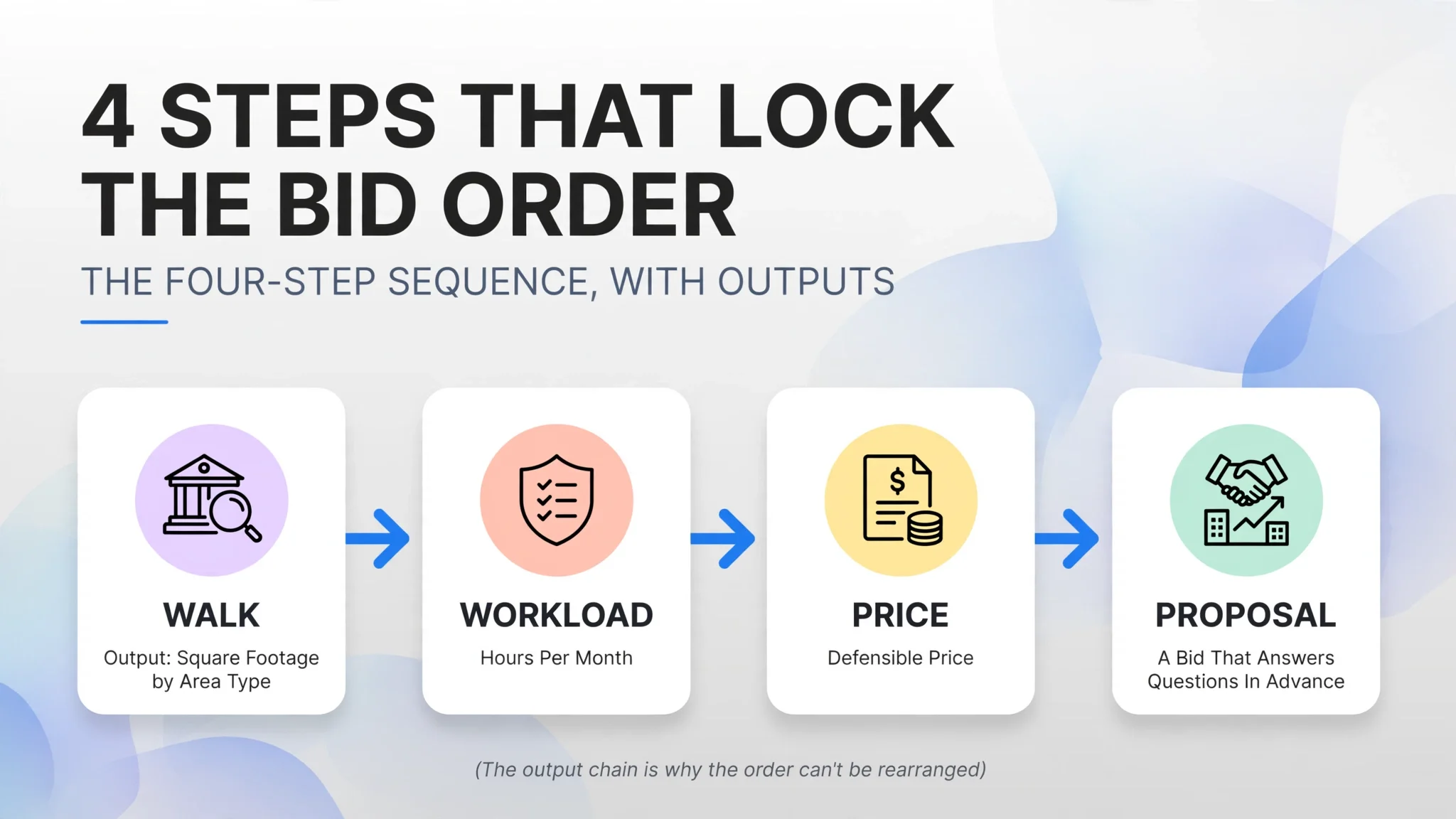
How to bid on cleaning contracts and actually win comes down to four steps in order: walk the site, calculate the workload, price the job from that workload, and build a proposal that shows the client exactly what they're buying. Skip a step and the bid gets weaker in a way the client'll see. Most losing bids skip the first and last steps, sending a number with nothing around it, and facility managers read a bare number as a sign of how you'd run the account.
I've been on both sides of this at ProCleanings and Verdant. Early on, I'd walk a building, do the math in my head, and email a monthly price. That's it. Then I started reading other companies' bids from the client side and realized why mine lost: next to a proposal with an area-by-area scope, a frequency table, and insurance certificates attached, my email looked like it came from one person with a mop. Everything around the price was costing me the work.
A winning cleaning bid is a sequence: walkthrough, workload, price, proposal. Do them in that order and the price is defensible and the proposal does the selling.
Why do most cleaning bids lose before the price is read?
Most cleaning bids lose before anyone reads the price because they look rushed: no scope, no frequency, no compliance documents. Facility managers use the quality of the proposal as a stand-in for the quality of the service.
Picture an owner who's grown for four years on word of mouth and has just started answering formal bids. In three months he's sent six, and won none. He's sure he's too expensive. He isn't. But each of those six was a short email with a monthly price and a line about "full janitorial service." The facility manager comparing his email against two proposals with area-by-area scope, a frequency table, and certificates of insurance doesn't need to open the pricing page to rank him third. If you've been wondering how to bid on cleaning jobs and keep losing, start there.
Here's the whole process, in order. Each step produces something the next one needs.
| Step | What you do | What you walk away with |
|---|---|---|
| 1. Walkthrough | Measure, count, photograph, and ask questions on site. | Square footage by area type, fixture counts, photos, and the client's priorities. |
| 2. Workload | Convert the building into labor hours using production rates and your walkthrough notes. | Hours per visit and per month. |
| 3. Price | Apply burdened labor cost, supplies, overhead, and margin to those hours. | A monthly price you can defend line by line. |
| 4. Proposal | Package scope, frequency, compliance, price, and terms. | A bid that answers the client's questions before they ask. |
Step 1: What should you do on the site walkthrough?
On the walkthrough, measure each area by type, count restrooms and fixtures, photograph the building's current condition, and ask the questions that shape the scope and the decision.
Measure square footage by area type rather than as one total: open office, private offices, restrooms, break rooms, lobbies, hard floors and carpet. Count restrooms, fixtures, trash points, and anything that slows a crew down, like a single elevator or a long walk to the dumpster. Photograph problem areas and existing damage, which helps you scope the work and protects you later if the client says you caused it.
Then ask. What's the current frequency, and what's the client unhappy with? What are the access hours and security rules? Are supplies and paper products included? Who decides, and by when? And why are they rebidding at all? That last answer tells you what the winning proposal has to fix.
Step 2: How do you calculate the workload?
Calculate the workload by dividing each area's square footage by a production rate for that kind of space, adjusting with what you saw on the walkthrough, and multiplying hours per visit by visits per month.
Published janitorial production rates give you a starting point for how fast different spaces clean. Open office moves fast; restrooms and private offices don't. Adjust those rates for what you saw: furniture density, floor condition, how far the crew walks between zones. Your own crews' timed rates'll beat anyone's published ones. Then multiply by frequency; a building cleaned five nights a week runs roughly 21.7 visits a month. The free commercial cleaning calculator handles that arithmetic once you have the hours.
Step 3: How do you price the job?
Price the job by multiplying labor hours by your burdened labor rate, adding supplies, adding overhead, and then dividing by one minus your target margin.
The step operators most often get wrong is labor cost. The U.S. Bureau of Labor Statistics puts the national median wage for building cleaning workers at $17.56 an hour (OEWS, May 2025), but that's not what an hour of labor costs you. Payroll taxes, workers' comp, and unemployment insurance push the true cost up, commonly to around 1.2 to 1.35 times the wage. Price on raw wage and a planned margin can quietly turn into a loss you won't see until payroll. The full method, with a worked example, is in the guide on how to price a commercial cleaning job.
Have your hours? Get your price. Run them through the free commercial cleaning calculator, then drop the result into your proposal.
Step 4: What goes into a winning cleaning proposal?
A winning cleaning proposal includes a short cover letter, an area-by-area scope of work, a frequency table, your compliance documents, the price, and your terms, in that order.
The cover letter shows you listened: name the building and the problem the client told you about on the walkthrough. The scope of work lists each area and the tasks in it. The frequency table shows what happens nightly, weekly, monthly, and quarterly. Compliance documents, meaning your certificate of insurance and workers' comp at minimum, go in the bid itself; don't write "available on request." Then there's the price, and finally terms: payment schedule, what's excluded, and how long the bid is valid.
If you're figuring out how to bid on commercial cleaning jobs against bigger competitors, this step is where you close the gap: a clear, specific proposal from a smaller company reads as more trustworthy than a polished generic one. See how to quote a commercial cleaning job for the full walkthrough-to-proposal sequence.
What bid mistakes cost cleaning companies the most?
The bid mistakes that cost the most are sending a price with no proposal, writing a generic scope, leaving out the insurance certificate, giving no expiration date, and never following up.
A price-only bid asks the client to trust you blind. A generic scope ("full janitorial service") tells them you didn't really look. A missing insurance certificate can get a bid set aside before it's even compared. No expiration date lets a client sit on your number for months while your costs rise. And no follow-up leaves the decision to whoever does call. Losing bids usually share two or three of these. The quoting side of these mistakes is in the guide to cleaning quoting mistakes.
How does ProTeams fit into the bidding process?
For steps 2 through 4, the free calculator handles the math; where ProTeams helps now is after you win, by proving the service you promised in the bid.
That matters more than it sounds. The proposal promised a scope and a frequency, and the client's going to check. Whether you're learning how to bid commercial cleaning jobs or you've been doing it for years, the bid you can't back up is the one you won't get to renew. ProTeams gives you timestamped check-ins, proof-of-service photos marked verified when they're taken on-site, no-show alerts, and a client portal where the facility manager can see schedules and report issues. On the Growth and Scale plans, reports go to the client automatically. That record is what wins the renewal, and the account after that. For the full path from finding bids to keeping accounts, see the playbook on how to get commercial cleaning contracts.
Frequently Asked Questions
How do I bid on a commercial cleaning contract?
Work four steps in order. Walk the site and note square footage by area type, fixtures, and the client's priorities. Convert that into labor hours using production rates. Price those hours with your burdened labor cost, supplies, overhead, and margin. Then send a proposal with an area-by-area scope, a frequency table, your insurance certificates, the price, and your terms.
What should I include in a commercial cleaning bid?
A short cover letter that reflects what you learned on the walkthrough, an area-by-area scope of work, a frequency table, your certificate of insurance and workers' comp, the price, and your terms, including what's excluded and how long the bid is valid. A price on its own, with none of that around it, usually loses to a complete proposal.
How do I calculate a commercial cleaning bid?
Estimate labor hours per visit from production rates and your walkthrough, multiply by visits per month, and multiply those hours by your burdened labor rate, which is the wage plus payroll taxes, workers' comp, and unemployment insurance. Add supplies and overhead, then divide by one minus your target margin. A free calculator can do the math once you have the hours.
Why do I keep losing cleaning bids?
Bids usually lose when they arrive as a bare number, use a generic scope, leave out insurance certificates, or never get a follow-up call. Compare your last few bids against a complete proposal, fix whatever's missing, and ask the client where you landed when you lose. That feedback is worth more than guessing.
Bid in order, and let the proposal sell
What the owner with six bids and no wins needed was the sequence: walk it, work it out, price it, and package it so the client can see what they're getting. Start with your next walkthrough — you'll feel the difference by the second bid. And when you win, back the proposal with proof.